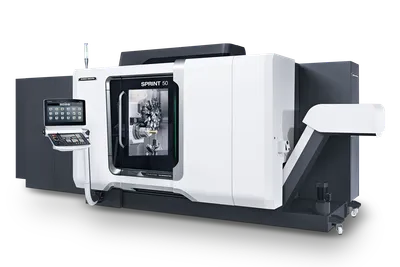
Hardinge GS-250
This model was not found in Hardinge's current lineup when we checked on 2026-10-03 . It may be a superseded or older model; the specifications below are as we last recorded them.
Key Specifications
X Travel
Z Travel
Max Spindle
Spindle Power
Max Turn Length
chuck size
How much does the Hardinge GS-250 cost?
Estimated price range
Our best estimate for a cnc lathes / turning center in this class — not a quote from Hardinge. Configuration moves it a long way.
Overview
The Hardinge GS-250 is a 250 mm (10 in) chuck turning center on box ways, with a 65 mm (2.56 in) bar capacity and a hydraulic, programmable tailstock. The listed envelope is 360 mm (14.17 in) in maximum turning diameter by 550 mm (21.65 in) in maximum turning length.
Everything in the table leans the same way. The ways are hardened and ground box ways, the machine weighs 4,500 kg (9,920 lb), and the spindle is listed at 18.5 kW (25 HP) continuous with 280 Nm (206 ft-lb) of torque and a 4,500 RPM top speed on an A2-6 nose. That is a specification for taking metal off steel and iron parts in a 10 in chuck, where mass and damping keep the cut quiet.
Travels are 210 mm (8.27 in) in X and 550 mm (21.65 in) in Z, and the tailstock makes the Z length usable for shafts as well as for chucked parts. Rapid traverse is 20 m/min (787 IPM) in X and 24 m/min (945 IPM) in Z. On heavy work the cut dominates the cycle, so these rates matter less than they would on small parts.
The turret is a 12-station VDI. The listed figures have no rows for live tooling, C-axis, sub-spindle or collet equipment, so regard the GS-250 as a turning machine unless a particular example shows more. A Fanuc 0i-TF Plus control is listed. Confirm the figures against the machine's documentation.
Full Specifications
| Parameter | Value |
|---|---|
| Chuck Size | 250 mm (10 in) hydraulic |
| Max Turning Diameter | 360 mm (14.17 in) |
| Max Turning Length | 550 mm (21.65 in) |
| Bar Capacity | 65 mm (2.56 in) |
| Spindle Nose | A2-6 |
| Max Spindle Speed | 4,500 RPM |
| Spindle Motor Power | 18.5 kW (25 HP) continuous |
| Spindle Torque | 280 Nm (206 ft-lb) |
| X-Axis Travel | 210 mm (8.27 in) |
| Z-Axis Travel | 550 mm (21.65 in) |
| Rapid Traverse X | 20 m/min (787 IPM) |
| Rapid Traverse Z | 24 m/min (945 IPM) |
| Turret | 12-station VDI |
| Guideway Type | Hardened and ground box ways |
| Tailstock | Hydraulic, programmable |
| CNC Control | Fanuc 0i-TF Plus |
| Machine Weight | 4,500 kg (9,920 lb) |
Specifications compiled from manufacturer literature and industry references. Not independently verified against a published spec sheet — confirm with the manufacturer or an authorised dealer before making a purchasing decision.
Strengths & Limitations
Strengths
- 280 Nm (206 ft-lb) of spindle torque with 18.5 kW (25 HP) continuous
- 250 mm (10 in) hydraulic chuck and 65 mm (2.56 in) bar capacity
- Hardened and ground box ways on a 4,500 kg (9,920 lb) machine
- Hydraulic, programmable tailstock with 550 mm (21.65 in) of Z travel
Limitations
- No live tooling or C-axis row in the listed figures
- 4,500 RPM top speed limits small-diameter work
- At 4,500 kg (9,920 lb) it needs a floor and lifting gear to match
- X rapid of 20 m/min (787 IPM) and Z rapid of 24 m/min (945 IPM) are slow for light, short-cycle parts
Best For
Frequently Asked Questions
01
Spindle torque is listed as 280 Nm (206 ft-lb), with 18.5 kW (25 HP) continuous and a maximum speed of 4,500 RPM. The listed figures do not include a torque curve, so the speed range over which full torque is available has to come from the machine's manual.
02
The chuck is a 250 mm (10 in) hydraulic type. Maximum turning diameter is 360 mm (14.17 in) and maximum turning length is 550 mm (21.65 in). Bar capacity is 65 mm (2.56 in) through an A2-6 spindle nose. X travel is 210 mm (8.27 in) and Z travel is 550 mm (21.65 in).
03
Yes. The guideways are listed as hardened and ground box ways. Together with a machine weight of 4,500 kg (9,920 lb), that favours heavy and interrupted cuts. The cost is axis speed: rapids are 20 m/min (787 IPM) in X and 24 m/min (945 IPM) in Z.
04
A tailstock, yes: it is listed as hydraulic and programmable. Live tooling is not mentioned. The turret is described only as a 12-station VDI, and there is no C-axis row, so do not count on milling without seeing it on the machine.
Videos

ComputerNumerical
actionmachinery

tiagobickel

Maxime FISCHER
Community Discussions
Troubleshooting and problem-solving
Links to community discussions. Summaries are editorial — visit the original thread for full context.
More from Hardinge
Hardinge Conquest GT 27
Hardinge Quest CHNC 27
Hardinge Elite 42M
Hardinge Conquest T42SP
Hardinge SV-150
Hardinge GS-200-66
Other CNC Lathes / Turning Centers
DN Solutions PUMA 5100 LYB
Chevalier FBL-530
Danobat Mikroturn Vertical 800V2