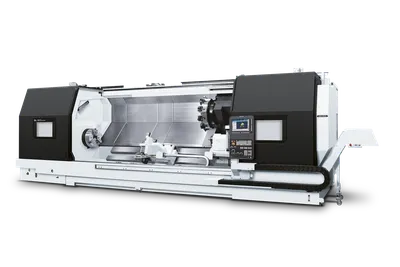
Hardinge GS-150
This model was not found in Hardinge's current lineup when we checked on 2026-10-03 . It may be a superseded or older model; the specifications below are as we last recorded them.
Key Specifications
X Travel
Z Travel
Max Spindle
Spindle Power
chuck size
maximum bar capacity
How much does the Hardinge GS-150 cost?
Estimated price range
Our best estimate for a cnc lathes / turning center in this class — not a quote from Hardinge. Configuration moves it a long way.
Overview
The Hardinge GS-150 is a 6 in (152 mm) chuck lathe on precision linear guideways, with a 42 mm (1.65 in) bar capacity and a 12-station VDI turret. The listed figures give a maximum turning diameter of 250 mm (9.84 in) and a maximum turning length of 350 mm (13.78 in).
Linear guideways set the character of the machine. Rapid traverse is 24 m/min (945 ipm) in X and 30 m/min (1,181 ipm) in Z, and at 2,800 kg (6,173 lb) the machine is light for its envelope. Both point to short-cycle production of small parts, where the time between cuts counts as much as the cuts themselves, more than to heavy or interrupted roughing.
The spindle reaches 5,000 RPM with 11 kW (15 hp) and a maximum torque of 140 Nm (103 ft-lb), through an A2-5 nose with a 42 mm (1.65 in) bore. X travel is 180 mm (7.09 in) and Z travel 350 mm (13.78 in). Bore and bar capacity are the same figure, so 42 mm bar is the limit with nothing in reserve for a liner.
Live tooling is listed as optional, and no C-axis row appears at all, so do not assume a GS-150 can mill. The listed control is a Fanuc 0i-TF. Nothing in the table covers a tailstock or sub-spindle. Settle those points, and confirm the listed figures, from the documentation of the particular machine.
Full Specifications
| Parameter | Value |
|---|---|
| Chuck Size | 6 in (152 mm) |
| Maximum Bar Capacity | 42 mm (1.65 in) |
| Maximum Turning Diameter | 250 mm (9.84 in) |
| Maximum Turning Length | 350 mm (13.78 in) |
| Max Spindle Speed | 5,000 RPM |
| Spindle Motor Power | 11 kW (15 hp) |
| Spindle Torque Max | 140 Nm (103 ft-lb) |
| Spindle Nose | A2-5 |
| Spindle Bore | 42 mm (1.65 in) |
| X-Axis Travel | 180 mm (7.09 in) |
| Z-Axis Travel | 350 mm (13.78 in) |
| Turret Stations | 12 (VDI) |
| Live Tooling | Optional |
| Guideway Type | Precision linear guideways |
| Rapid Traverse X | 24 m/min (945 ipm) |
| Rapid Traverse Z | 30 m/min (1,181 ipm) |
| CNC Control | Fanuc 0i-TF |
| Machine Weight | 2,800 kg (6,173 lb) |
Specifications compiled from manufacturer literature and industry references. Not independently verified against a published spec sheet — confirm with the manufacturer or an authorised dealer before making a purchasing decision.
Strengths & Limitations
Strengths
- Rapid traverse of 24 m/min (945 ipm) in X and 30 m/min (1,181 ipm) in Z on precision linear guideways
- Maximum spindle torque of 140 Nm (103 ft-lb) with 11 kW (15 hp) at up to 5,000 RPM
- 42 mm (1.65 in) spindle bore and bar capacity behind a 6 in (152 mm) chuck
- At 2,800 kg (6,173 lb) it asks little of the floor and the rigging
- 12-station VDI turret, enough positions to keep a full bar-work tool set mounted
Limitations
- Live tooling is optional and no C-axis is listed, so milling cannot be assumed
- Linear guideways and a 2,800 kg (6,173 lb) build suit light and medium cuts better than heavy interrupted roughing
- 350 mm (13.78 in) maximum turning length with no tailstock in the listed figures
- Spindle speed stops at 5,000 RPM, which limits surface speed on very small diameters
Best For
Frequently Asked Questions
01
Precision linear guideways, in the listed figures. They allow the quick axis moves the table shows, 24 m/min (945 ipm) in X and 30 m/min (1,181 ipm) in Z. The general trade is less damping than box ways under heavy or interrupted cuts, so match the machine to light and medium turning.
02
Live tooling is listed as optional, so some machines have it and some do not. The listed figures give no live-tool speed or power and no C-axis row. If milled or cross-drilled features are part of the job, confirm that the specific machine has driven tooling and spindle indexing.
03
A 6 in (152 mm) chuck, 42 mm (1.65 in) maximum bar capacity through a 42 mm (1.65 in) spindle bore, 250 mm (9.84 in) maximum turning diameter and 350 mm (13.78 in) maximum turning length. Axis travels are 180 mm (7.09 in) in X and 350 mm (13.78 in) in Z.
04
It is listed at 11 kW (15 hp) with a maximum torque of 140 Nm (103 ft-lb) and a top speed of 5,000 RPM, on an A2-5 nose. The table does not say whether the power figure is continuous or short-term, which is worth asking before planning long roughing cuts.
Videos

MTDCNC
1stmachineryauctions

The Engineering Technology Group Limited
Community Discussions
Troubleshooting and problem-solving
Links to community discussions. Summaries are editorial — visit the original thread for full context.
More from Hardinge
Other CNC Lathes / Turning Centers
Pinnacle PK-L210C/DMY
DN Solutions PUMA 3100 ULY
Chevalier FBL-510
Danobat Mikroturn Twin spindle