Industrial CNC Machine Directory

Euroturn 8/32

$550,000 - $1,000,000 Updated 2026-03-17
01

Key Specifications

Max Spindle

5,500 RPM per spindle

Accuracy

0.005 mm

number of spindles

8

max bar diameter

32 mm (1.26 in)

spindle speed independent

Yes

cross slide stroke

70 mm (2.8 in)

02

Overview

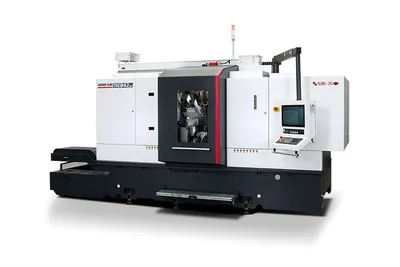
The Euroturn 8/32 is a CNC multi-spindle automatic turning machine for bar stock up to 32 mm diameter with 8 spindles, produced by Euroturn GmbH. The 8/32 designation identifies the two defining characteristics: 8 spindles operating simultaneously and 32 mm maximum bar capacity. The addition of two spindles beyond the conventional 6-spindle format significantly increases the machine's throughput potential — 8 simultaneous cutting operations versus 6 — making the 8/32 particularly well-suited to the highest-volume production programs where every marginal throughput increment has measurable cost impact.

The combination of 8 spindles and 32 mm bar capacity places the Euroturn 8/32 in a competitive position within the medium-sized CNC multi-spindle market. At 32 mm, the machine covers a broad range of automotive components including ABS sensor bodies, transmission housing inserts, suspension component blanks, and fuel rail end caps. The 8-spindle architecture extends the throughput advantage further than 6-spindle competitors at the same bar diameter — for equal cycle time per station, an 8-spindle machine produces 33% more parts per hour than a 6-spindle machine.

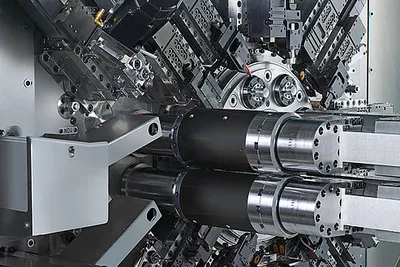
The 8-spindle drum arrangement creates additional geometric complexity compared to 6-spindle designs. More spindle stations mean more opportunities to distribute machining operations, potentially reducing the cycle time per station (and therefore the overall machine cycle time) by spreading operations across 8 positions rather than 6. For complex parts requiring 7 or more distinct operations, the 8-spindle format allows each operation to have its own dedicated station with no combined-operation compromise, which simplifies tooling setup and improves dimensional repeatability.

CNC servo control at each cross-slide and longitudinal station provides the programmability that differentiates the 8/32 from mechanical cam multi-spindles. Program changes can be executed in 4-8 hours for a complete job changeover, enabling the machine to serve multiple product families across a production week. Live tooling at designated stations allows milling, cross-drilling, and polygon forming within the cycle. The optional back-working attachment provides rear-face, back-drill, and back-thread capability for fully completed parts.

Pricing for the Euroturn 8/32 typically ranges from $550,000 to $1,000,000 depending on live tooling configuration, back-working attachment, control specification, and bar feed integration. The 8-spindle format commands a price premium over 6-spindle 32 mm machines, justified by the throughput advantage for high-volume programs. Investment is typically justified at sustained annual volumes of 1,000,000+ parts per product family.

03

Full Specifications

Parameter Value
Number Of Spindles 8
Max Bar Diameter 32 mm (1.26 in)
Max Spindle Speed 5,500 RPM per spindle
Spindle Speed Independent Yes
Cross Slide Stroke 70 mm (2.8 in)
Longitudinal Stroke 115 mm (4.5 in)
Tool Stations Up to 16 cross tools + 8 longitudinal
Live Tooling Yes
Back Working Yes (optional)
Positioning Accuracy 0.005 mm
Machine Weight 18,000 kg (39,683 lb)
CNC Control Siemens 840D or Fanuc 30i
Bar Feed Magazine bar feeder (32 mm capacity)
Parts Per Minute Varies by part; typically 1.5-4.5 ppm

Specifications sourced from gosiger.com — verified 2026-03-28

04

Strengths & Limitations

Strengths

  • 8-spindle architecture produces 33% more parts per hour than comparable 6-spindle 32mm machines at equal per-station cycle times — a meaningful throughput increment at million-plus annual volumes
  • 8 stations allow each machining operation to occupy its own dedicated station, simplifying tooling layout and improving dimensional repeatability compared to multi-operation station arrangements
  • 32 mm bar capacity covers ABS sensor bodies, transmission housing inserts, and fuel rail end caps — high-volume automotive components well-suited to multi-spindle economics
  • CNC programmability with 4-8 hour changeover enables multi-product production across a work week, allowing the machine to serve several high-volume part families rather than single-part dedication
  • German engineering construction provides durability and thermal stability for demanding automotive production environments with 2-3 shift daily operation

Limitations

  • 8-spindle configuration adds mechanical complexity versus 6-spindle machines — more spindle bearings, more servo axes, and more tooling positions increase maintenance requirements and spare parts inventory
  • Capital cost premium over 6-spindle alternatives ($550K-$1M) requires the highest production volumes to recover — lower-volume programs lose the throughput advantage that justifies the price increment
  • 32 mm bar maximum leaves a gap below the 6/52 for larger components — shops with products across the 32-52 mm range need multiple platforms
05

Best For

Highest-volume automotive component manufacturers producing ABS sensor housings, fuel rail fittings, and suspension component blanks in the 20-32 mm range at 2,000,000+ parts annually Transmission component producers running valve spool bodies, accumulator pistons, and hydraulic control component blanks requiring 7 or more distinct machining operations Hydraulic component manufacturers producing NPT 1/2" and 3/4" fitting bodies in brass and steel at very high volumes where 8-spindle throughput provides measurable cost advantage over 6-spindle machines Industrial fastener manufacturers producing large precision bolts, studs, and threaded inserts in the 25-32 mm range at annual volumes where per-piece cost fractions of a cent matter
06

Frequently Asked Questions

01 What is the throughput advantage of 8 spindles vs 6 spindles at 32mm bar?

For a 32 mm ABS sensor housing in stainless 303 (7 turning/drilling operations): 6-spindle machine must combine at least 1 station's operations, leading to a station cycle time of approximately 18-25 seconds. 8-spindle machine can assign one operation per station, reducing bottleneck station time to approximately 12-18 seconds. At 12 seconds/cycle: 6-spindle = 300 parts/hour; 8-spindle = 300 parts/hour — same if cycle time reduces proportionally. At 18 seconds/cycle: 6-spindle bottleneck at combined station = 200 parts/hour; 8-spindle dedicated stations = 200 parts/hour at separate cycle. Real advantage: for complex 7-8 operation parts, the 8-spindle eliminates combined-station bottlenecks and enables 15-30% faster cycle times than a 6-spindle attempting the same part. At 3,000,000 parts/year, 30% faster cycle time = 1 less machine required.

02 How are 8 spindle stations typically assigned for an automotive ABS sensor housing?

Typical station assignment for a 32mm ABS sensor housing (stainless 303): Station 1 — Face + center drill front end; Station 2 — Turn major OD diameter, rough; Station 3 — Turn major OD diameter, finish + groove; Station 4 — Drill central bore (live tooling or fixed drill); Station 5 — Bore inner diameter to size + chamfer; Station 6 — Thread major bore (M24 or equivalent) using live threading unit; Station 7 — Cross-drill side port (live tooling, radial drill); Station 8 — Cutoff + deburr chamfer. Back-working (if fitted): Back face + back chamfer. This 8-station layout places one operation per station, ensuring no station is overloaded and cycle time is balanced across the drum. With 6 spindles, stations 1-2 and 7-8 would need to be combined, creating a busier station with longer cycle time.

03 What live tooling configurations are available for the Euroturn 8/32?

The Euroturn 8/32 live tooling configurations include: (1) Radial (cross) live tooling — live milling spindle mounted at cross-slide, perpendicular to main spindle axis, for radial drilling, milling, and slotting. Typical speeds: 3,000-8,000 RPM, power 0.5-1.5 kW per live unit. (2) Axial live tooling — mounted parallel to main spindle, for face drilling, tapping, and end-working within the machine cycle. (3) Polygon milling — synchronized live spindle running at speed ratio to main spindle for hex/square milling without C-axis indexing stop. (4) B-axis or angular live tooling — available in some configurations for angular drilling (45° cross-holes on valve bodies). Up to 4 live tooling positions are typically available across the 8 cross-slide stations. Maximum live tool diameter for radial milling: approximately 20 mm end mill at 32 mm workpiece OD.

04 How does the Euroturn 8/32 compare to the Index MS 32 8-spindle?

Euroturn 8/32 vs Index MS 32 (8-spindle version, 32 mm max): Both are 8-spindle CNC multi-spindle automatics at 32 mm bar capacity. Key differences: (1) Index-Traub has a substantially larger global service and applications network, particularly in North America and Western Europe — this is the most significant practical differentiator for many buyers; (2) Index has deeper published application experience and regional demo centers; (3) Pricing — Euroturn may offer competitive pricing as an independent manufacturer, while Index commands a premium for its established brand and service network; (4) Control: Index uses Fanuc 30i or Index C200-4D; Euroturn uses Siemens 840D or Fanuc 30i. For European manufacturers with access to Euroturn's regional service, the 8/32 is a credible alternative to the Index MS 32. For North American buyers, Index-Traub's local service infrastructure is typically a decisive factor.

05 What is the electrical and utility specification for installing the Euroturn 8/32?

Euroturn 8/32 installation utilities: (1) Electrical: 400 VAC 3-phase, minimum 60-80 kVA supply for machine + auxiliaries including bar feeder, coolant system, and chip conveyor; dedicated disconnect and appropriate circuit protection per IEC 60204-1; (2) Compressed air: 6-7 bar, minimum 400 L/min for machine pneumatics, chip blowing, and coolant system; (3) Coolant drainage: 100 mm minimum drain connection for coolant overflow and maintenance drainage; (4) Floor loading: 18,000 kg machine requires 6,000 kg/m² minimum slab capacity in footprint area; (5) Total cell footprint: approximately 40-55 square meters including 4-meter bar feeder, parts conveyor, and access clearances; (6) Lifting and installation: machine is installed as sections using overhead crane or forklift rated 5,000 kg minimum; (7) Thermal environment: optimal operating temperature 18-22°C ambient for dimensional stability — machine includes coolant temperature control but ambient extremes affect thermal drift.

07

Videos

Euroturn (Mori-Say) 8-32 Multi-Spindle Screw Machine

Euroturn (Mori-Say) 8-32 Multi-Spindle Screw Machine

Graff-Pinkert's Videos

ZPS 8/32 For Sale, (EUROTURN, MORI-SAY), Low Hours, CNC Slides

ZPS 8/32 For Sale, (EUROTURN, MORI-SAY), Low Hours, CNC Slides

Adam Wiltsie

Sargent Co  01 1495 Machine Screw #8 32 X 5 8 inch

Sargent Co 01 1495 Machine Screw #8 32 X 5 8 inch

RICHARD HOWARD

ZPS MORI-SAY 6/32 Multi-Spindle Automatic Lathe with Bar Fee

ZPS MORI-SAY 6/32 Multi-Spindle Automatic Lathe with Bar Fee

Surplex

Euroturn Mori-Say 6/32M CNC multispindle screw machine 2003

Euroturn Mori-Say 6/32M CNC multispindle screw machine 2003

Graff Machine Tools, LLC

08

Community Discussions

09

Related Machines