Industrial CNC Machine Directory

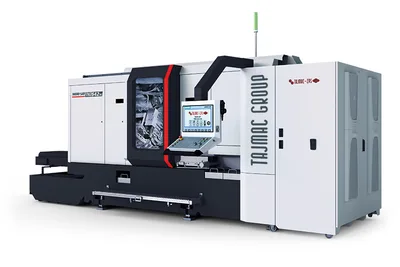
Euroturn 6/52

$650,000 - $1,200,000 Updated 2026-03-17
01

Key Specifications

Max Spindle

3,500 RPM per spindle

Accuracy

0.006 mm

number of spindles

6

max bar diameter

52 mm (2.05 in)

spindle speed independent

Yes

cross slide stroke

90 mm (3.5 in)

02

Overview

The Euroturn 6/52 is a CNC multi-spindle automatic turning machine for bar stock up to 52 mm diameter with 6 spindles, produced by Euroturn GmbH. At 52 mm maximum bar capacity, the 6/52 is the largest machine in Euroturn's multi-spindle lineup, entering the territory of medium-to-large precision turned components that have historically been produced on single-spindle CNC lathes or cam-operated mechanical multi-spindles. The 6/52 brings CNC programmability and flexible production to this large-bar tier, enabling economic production of complex components at volumes previously requiring mechanical cam multi-spindle investment.

The 52 mm bar capacity covers a substantial range of industrial components: large hydraulic cylinder end caps and piston rod ends, medium-bore valve bodies for industrial process control, automotive differential bearing housing blanks, large pneumatic actuator components, and medium-sized flanged fitting bodies. These components are common in the oil and gas, industrial automation, automotive drivetrain, and construction equipment supply chains — industries that consistently run high annual volumes of a relatively small number of part numbers, the ideal production profile for multi-spindle economics.

CNC servo control at each of the six spindle stations provides the programmability that distinguishes the 6/52 from cam multi-spindles in this bar range. Changing from one part family to another requires 5-10 hours of setup rather than the 2-4 days required for cam replacement and grinding. For shops running 5-10 large-bar component families with annual volumes in the 50,000-500,000 range per family, the CNC changeover economy is a decisive advantage over cam machines. The ability to make programmatic adjustments for tool wear or dimensional drift during a production run — without mechanical intervention — further reduces the operator skill requirement compared to cam machine operation.

At 52 mm bar diameter, material considerations become more critical than at smaller bar sizes. The 6/52 is routinely applied to carbon steel, alloy steel (4140, 4340), stainless steel (303, 316), ductile iron, and aluminum alloys in this size range. The machine's rigid frame construction, heavy spindle bearings, and powerful servo drives are designed to handle the higher cutting forces inherent in 52 mm bar machining without compromising dimensional repeatability.

Pricing for the Euroturn 6/52 typically ranges from $650,000 to $1,200,000 depending on configuration. The machine is positioned as a capital-intensive production platform for manufacturers with committed high-volume programs, offering long-term cost-per-part advantages over single-spindle turning center fleets in the appropriate volume range. Euroturn's European manufacturing and service infrastructure supports the machine within European industrial markets.

03

Full Specifications

Parameter Value
Number Of Spindles 6
Max Bar Diameter 52 mm (2.05 in)
Max Spindle Speed 3,500 RPM per spindle
Spindle Speed Independent Yes
Cross Slide Stroke 90 mm (3.5 in)
Longitudinal Stroke 140 mm (5.5 in)
Tool Stations Up to 14 cross tools + 6 longitudinal
Live Tooling Yes
Back Working Yes (optional)
Positioning Accuracy 0.006 mm
Machine Weight 25,000 kg (55,115 lb)
CNC Control Siemens 840D or Fanuc 30i
Bar Feed Magazine bar feeder (52 mm capacity)
Parts Per Minute Varies by part; typically 0.5-2 ppm
04

Strengths & Limitations

Strengths

  • 52 mm bar capacity is among the largest in the CNC multi-spindle class, covering medium hydraulic cylinder fittings, large valve body blanks, and differential housing components not accessible to smaller multi-spindle machines
  • CNC programmability at 52mm bar provides 5-10 hour changeover vs 2-4 days for cam multi-spindles in this range, enabling economic multi-product production programs
  • Heavy frame and large spindle bearing construction provides rigidity for consistent material removal on alloy steel and stainless at large bar diameters without dimensional drift
  • 6-spindle simultaneous production at 52mm provides 3-5x throughput advantage over single-spindle CNC turning, enabling significant machine count reduction for sustained large-bar production programs
  • German manufacturing standards provide quality and durability credentials for industrial supply chains in oil and gas, automotive drivetrain, and construction equipment sectors

Limitations

  • 52 mm bar maximum is a hard constraint for components requiring larger stock — true large-bore components above 52 mm require dedicated chucking lathes or cam multi-spindles with larger spindle bores
  • Capital cost of $650K-$1.2M is substantial and requires rigorous financial justification — typically only appropriate for manufacturers with committed long-term volume programs of 200,000+ parts annually
  • At 52 mm bar and 3,500 RPM maximum, peripheral speed is 288 m/min at maximum diameter — lower than smaller-bar machines, requiring careful cutting parameter management for materials requiring high surface speeds
05

Best For

Hydraulic cylinder manufacturers producing piston rod end blanks, cylinder cap components, and large bore fitting bodies in the 40-52 mm range for mobile and industrial hydraulic systems Industrial valve manufacturers producing process control valve body blanks, gate valve seats, and actuator housing components in stainless and carbon steel for oil and gas applications Automotive drivetrain suppliers producing differential bearing housing blanks, axle end components, and transmission housing inserts in alloy steel at sustained high volumes Construction equipment component manufacturers producing hydraulic motor end cap blanks, swing motor housing components, and steering cylinder end fittings in large bar format
06

Frequently Asked Questions

01 What is the throughput comparison for the 6/52 vs CNC turning on large hydraulic cylinder components?

For a hydraulic cylinder rod end blank (50 mm diameter, 1045 steel, 5 turning operations + 1 boring + 1 threading): Single-spindle CNC turning center: 120-180 seconds = 20-30 parts/hour. Euroturn 6/52 at 6 spindles: 20-35 seconds cycle per station = 103-180 parts/hour. Throughput advantage: 4-6x. For a mobile hydraulic equipment supplier running 200,000 rod end blanks annually: single-spindle turning requires 6,700-10,000 machine hours (approximately 4-5 CNC lathes); the 6/52 requires 1,110-1,940 hours (approximately 1 machine). This represents elimination of 3-4 CNC turning centers — approximately $600,000-$1,200,000 in avoided machine purchases — and proportional reductions in operator headcount and facility space.

02 How does the Euroturn 6/52 compare to cam multi-spindles in the 52mm class?

Euroturn 6/52 (CNC) vs Davenport or National Acme cam multi-spindles at 52 mm: (1) Changeover time: 6/52 requires 5-10 hours for a complete CNC program change; cam multi-spindles require 2-4 days for cam replacement, grinding, and setup — a decisive advantage for shops running 5+ part families. (2) Minimum economic batch size: 6/52 is economic at 30,000-100,000 parts per run; cam multi-spindles typically require 500,000+ parts per cam set to amortize cam fabrication. (3) Complex geometry: 6/52 CNC enables tapered profiles, compound curves, and programmatic lead variation impossible on cam machines. (4) Production rate: at high volumes on simple parts, cam multi-spindles can achieve slightly shorter cycle times due to mechanical timing precision vs servo positioning overhead. (5) Total cost: for mixed-volume programs, the 6/52 is almost always more economical. For single-part, single-speed production programs at millions per year, cam machines remain competitive.

03 What alloy steel grades can the Euroturn 6/52 machine at 52mm bar?

The Euroturn 6/52 machines the following alloy steels at 52 mm bar diameter: (1) 1045 medium carbon steel — most common for hydraulic cylinder and general engineering components; cutting speed 150-200 m/min coated carbide, feed 0.15-0.3 mm/rev; (2) 4140 chromium-molybdenum steel (pre-hardened 28-34 HRC) — for high-strength rod ends and coupling bodies; cutting speed 120-160 m/min, requires tough insert grades; (3) 4340 nickel-chromium-molybdenum steel — for aerospace and high-strength industrial components; cutting speed 100-140 m/min; (4) 303 free-machining stainless — for valve and fitting bodies; cutting speed 100-130 m/min; (5) 316L austenitic stainless — for corrosion-resistant process control components; cutting speed 80-110 m/min with positive-rake inserts; (6) Ductile iron grades 65-45-12 and 80-55-06 — for hydraulic housing and valve body castings; cutting speed 150-220 m/min. Material selection significantly affects insert grade, cutting parameters, and coolant strategy — Euroturn application engineering support is recommended for initial process setup on new materials.

04 What foundation requirements does the Euroturn 6/52 have?

Euroturn 6/52 foundation and installation requirements: (1) Machine weight 25,000 kg requires minimum 6,500 kg/m² floor slab bearing capacity in the machine footprint — typically a 300-350 mm thick reinforced concrete slab per structural engineer specification; (2) Machine is installed on leveling mounts or epoxy grouted sole plates per Euroturn installation drawing; (3) Electrical: 400 VAC 3-phase, 80-100 kVA supply for machine + bar feeder + chip conveyor; (4) Compressed air: 6-7 bar, 500 L/min peak for all machine pneumatics; (5) Coolant drainage: 150 mm floor drain with sediment trap in machine foundation area; (6) Overhead clearance: 4.0 meters minimum for bar loading and maintenance crane access; (7) Total cell footprint: 50-70 square meters including 4-5 meter bar feeder, chip conveyor, and 1.5 meter access clearances on all service sides; (8) Fork truck or overhead crane rated 8,000 kg minimum for machine installation and major maintenance; (9) Vibration isolation recommended if installed near stamping presses or other high-vibration equipment.

05 What back-working operations does the 6/52 optional attachment provide?

The Euroturn 6/52 back-working attachment enables the following operations on the parted-off end of the bar: (1) Back facing — finish facing of the cutoff end surface to achieve flatness required for sealing faces on hydraulic fitting bodies; (2) Center drilling — producing center hole on the back face for downstream between-centers turning or grinding operations; (3) Chamfering — deburring and chamfering of the cutoff end edge; (4) Back drilling — drilling axial holes from the rear face (separate from front-face bore produced in the main cycle); (5) Back threading — tapping or thread milling of rear axial threads; (6) Back boring — enlarging or finishing a rear axial bore to tighter tolerance than achievable in the main cycle. The back-working cycle operates simultaneously with the main spindle cycle — the 6/52 processes a new bar segment in the main cycle while the back-working attachment processes the previously cut-off part. This parallel operation does not add to the total cycle time if back-working operations can be completed within the main cycle time window.

07

Community Discussions

08

Related Machines