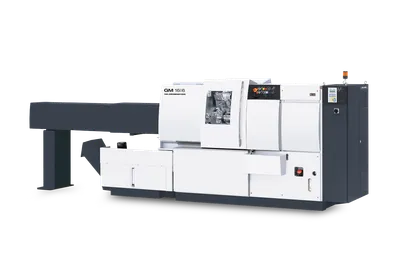
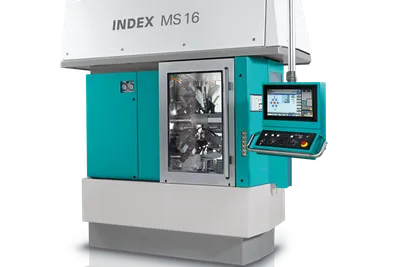
Hydromat Rotary Transfer Machine
Key Specifications
Max Spindle
Max Turn Length
machine type
number of stations
table diameter
max workpiece weight
Overview
The Hydromat Rotary Transfer Machine is a multi-station CNC rotary transfer platform representing a fundamentally different production architecture from multi-spindle automatics or single-spindle turning centers. In a rotary transfer configuration, workpieces are held in fixtures on a rotary indexing table and transferred sequentially through a series of fixed machining stations—each station performing a dedicated operation (turning, milling, drilling, tapping, reaming) simultaneously on different workpieces. Hydromat, headquartered in St. Louis, Missouri, is the dominant North American builder of CNC rotary transfer machines and has established the EPIC (Electronic Positioning and Indexing Control) platform as the industry standard for rotary transfer production.
The 24-station configuration—Hydromat's largest platform—positions 24 workpiece stations around the rotary table, each moving to the next machining station with every index cycle. All 24 stations machine simultaneously, meaning one complete part is produced with every index cycle. For high-volume prismatic and chucked component production requiring many different machining operations, this architecture delivers throughput and flexibility unavailable from any single-spindle or multi-spindle turning alternative.
Unlike multi-spindle automatics that work exclusively on bar stock in turning operations, rotary transfer machines handle chuck-loaded blanks, castings, forgings, and pre-formed parts that require turning, drilling, milling, boring, and threading in combination. This makes the Hydromat the production platform of choice for automotive hydraulic bodies, brake calipers, power steering components, and industrial valve bodies where the mix of turning and prismatic operations within a single production cycle defines the part.
Hydromat's EPIC control provides CNC programmability at each machining station with Fanuc servo drives and modern CNC axes, enabling relatively quick changeover compared to older mechanically-fixed transfer machines. The system supports full statistical process control monitoring, tool life management, and industry 4.0 data connectivity.
Full Specifications
| Parameter | Value |
|---|---|
| Machine Type | CNC Rotary Transfer Machine |
| Number Of Stations | Up to 24 machining stations |
| Table Diameter | Approx. 2,400 mm (94.5 in) for 24-station |
| Max Workpiece Weight | Up to 10 kg (22 lb) per fixture |
| Horizontal Spindle Power | Up to 7.5 kW (10 hp) per station |
| Vertical Spindle Power | Up to 5.5 kW (7.5 hp) per station |
| Spindle Speed Range | Up to 6,000 RPM per station |
| Index Time | Approx. 1.5–2.5 seconds per index |
| CNC Control | Hydromat EPIC (Fanuc-based) |
| Machine Weight | Approx. 35,000–60,000 kg depending on configuration |
| Floor Space | Approx. 6,000 mm × 6,000 mm (24-station) |
| Max Spindle Speed | 8,500 RPM (Mill / Drill Units) and 5000 RPM (Lathe Turning) |
| Turret Stations | 12 or 16 horizontal machining stations and 6 or 8 vertical machining stations |
| Max Turning Diameter | 1.75 Inch Round, 1.5 Inch Hex, 1.25 Inch Square |
| Max Turning Length | 6 Inches |
| Cnc Control | FANUC 30i-B |
Specifications sourced from hydromat.com — verified 2026-03-28
Strengths & Limitations
Strengths
- [object Object]
- [object Object]
- [object Object]
- [object Object]
Limitations
- [object Object]
- [object Object]
- [object Object]
- [object Object]
Best For
Frequently Asked Questions
01
A rotary transfer machine indexes workpieces through a series of fixed machining stations, with all stations operating simultaneously on different parts. A conventional machining center processes one part at a time through multiple operations at a single station. For complex parts requiring many operations at high volumes, rotary transfer machines deliver 5–15x the throughput of machining centers by performing all operations in parallel.
02
Hydromat rotary transfer machines range from approximately $1.5 million for smaller configurations to $4 million or more for fully-equipped 24-station systems with all machining attachments. The wide price range reflects the number of active machining stations and the complexity of tooling and fixturing for specific part applications.
03
Parts-per-hour output depends on the index cycle time, which equals the time required for the longest single-station operation. For automotive components with cycle times of 20–40 seconds, a 24-station Hydromat produces 90–180 completed parts per hour—equivalent to a cell of 10–15 machining centers running the same operations sequentially.
04
Rotary transfer machines can be changed over to different parts, but changeover requires new fixtures, new tooling for each station, and engineering time to rebalance operations across stations. Changeover cost and time is significantly higher than for CNC machining centers or turning centers, which is why rotary transfer machines are dedicated to long-life, high-volume production programs.
05
Industry rule of thumb is that rotary transfer economics justify investment at annual volumes above 300,000–500,000 identical parts per year for complex multi-operation components. Below this volume, the setup cost amortization, fixture investment, and machine cost per part exceed what machining centers with automation can deliver.
Videos
Hydromat
Pfiffner Rotary Transfer Machines Rundtaktmaschinen
The Branford Group
Graff-Pinkert's Videos
Hydromat
Community Discussions
Community discussion — Manufacturing in America and Europe | Hydromat openings or ...
Community discussion — Buying and Selling Used Hydromats - Practical Machinist
Owner experience and review — Hydromat Setup/Operator s Needed (4) - Practical Machinist
Owner experience and review — Over coming a Poor work history - Practical Machinist
Community discussion — Hydromat Set-Up/Operator - 4 positions - Great Opportunity
Owner experience and review — My Fadal 4020 Kflop Retrofit - cnczone.com
Troubleshooting and problem-solving — Need Help! Rotary 4th axis and tool planes not working - CNCzone
Community discussion — What does a 4-axis CNC machine look like? - CNCzone
Pricing and buying discussion — Looking for help laying out Hydromat rotary transfer jobs on ...
Community discussion — Water jet recommendations? : r/Machinists - Reddit
Maintenance and service — Is anyone considering a Protomax? : r/Machinists - Reddit
Community discussion — God I love waterjet machines : r/Machinists - Reddit
Links to community discussions. Summaries are editorial — visit the original thread for full context.