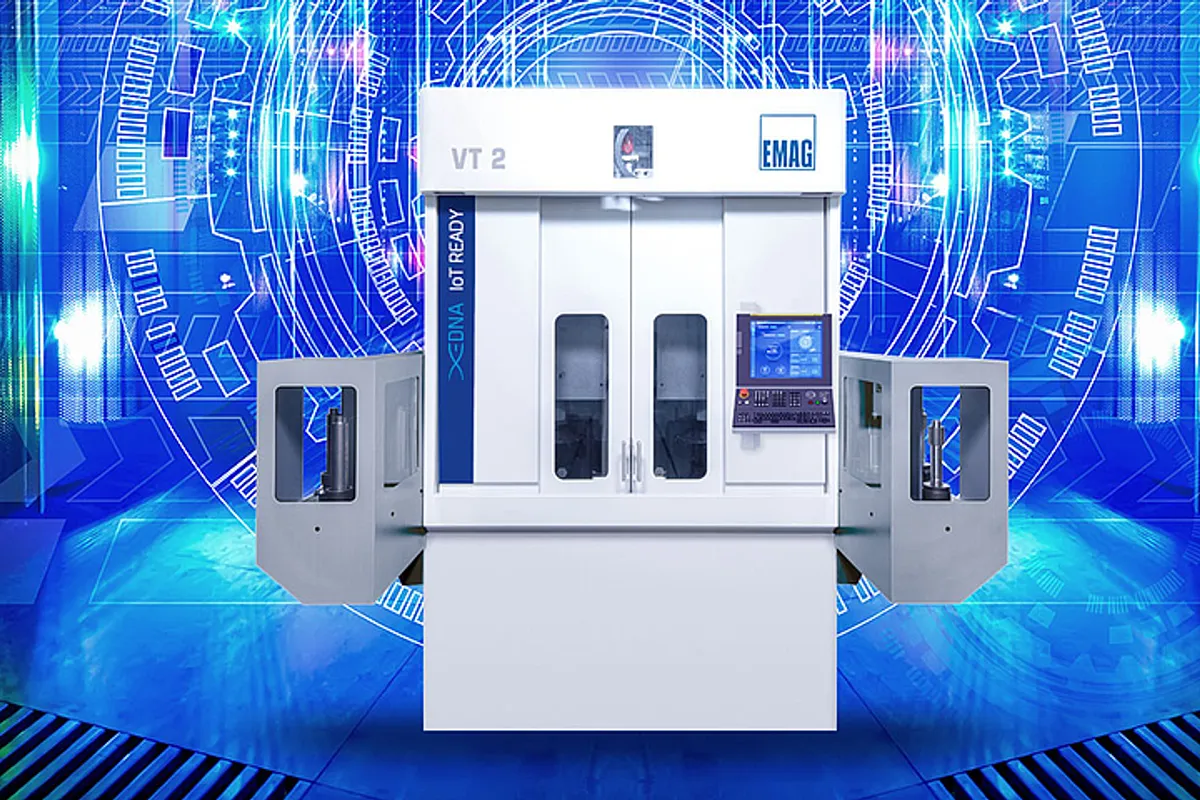
EMAG VT 2
Key Specifications
X Travel
Z Travel
Max Spindle
Spindle Power
Max Workpiece ⌀
max workpiece length
How much does the EMAG VT 2 cost?
Estimated price range
Our best estimate for a cnc lathes / turning center in this class — not a quote from EMAG. Configuration moves it a long way.
Overview
The EMAG VT 2 is the smaller of the VT shaft-turning machines on this site: it takes workpieces up to 100 mm (4 in) in diameter and 400 mm (15.5 in) long, holds them in a 160 mm (6.5 in) chuck and turns them at up to 6,000 rpm. EMAG gives a maximum turning diameter of 160 mm (6.3 in) and a swing of 210 mm (8.5 in) for it.
The proportions say what the machine is for. A part four times longer than its widest diameter is a shaft, and the axes are laid out for that: Z travel is 625 mm (24.5 in), comfortably more than the 400 mm part length, while X travel is 332 mm (13 in). Rotor shafts, gear shafts and similar slender parts in the small-diameter range are the natural work.
The spindle is rated 21/14.1 kW (28/19 hp) and 130/90 Nm (96/66 ft-lb). The table gives two figures for each without saying which duty cycle they belong to, so ask EMAG which value applies to a long roughing cut before planning feeds around the higher one. The 6,000 rpm top speed suits the small diameters this machine is sized for, where surface speed runs out long before torque does.
The machine has two linear axes, X and Z, with a C-axis for driven tools, and the driven tools run to 6,000 RPM. That allows cross holes, flats and similar secondary features to be cut in the same clamping as the turning. No Y axis is listed.
Against its larger siblings the VT 2 trades capacity for speed. The VT 200 and VT 4 both carry a 250 mm (10 in) chuck, 395 mm (15.5 in) of X and 810 mm (32 in) of Z, with 38/29 kW (51/39 hp) and 250/200 Nm (184/148 ft-lb) but only 4,500 rpm. The VT 2 needs a 400V, 3-phase supply.
Full Specifications
| Parameter | Value |
|---|---|
| Max Workpiece Diameter | 100 mm (4 in) |
| Max Workpiece Length | 400 mm (15.5 in) |
| Power Supply | 400V, 3-phase |
| Max Turning Diameter | 160 mm (6.3 in) |
| Max Spindle Speed | 6,000 rpm |
| Spindle Motor Power | 21/14.1 kW (28/19 hp) |
| Spindle Torque | 130/90 Nm (96/66 ft-lb) |
| Turret Driven Tool Speed | 6,000 RPM |
| Axes | 2 (X, Z) with C-axis for driven tools |
| Chuck Size | 160 mm (6.5 in) |
| Max Swing | 210 mm (8.5 in) |
| X-Axis Travel | 332 mm (13 in) |
| Z-Axis Travel | 625 mm (24.5 in) |
Specifications sourced from emag.com — verified 2026-10-03
Strengths & Limitations
Strengths
- 6,000 rpm main spindle, faster than the 4,500 rpm of the VT 200 and VT 4, suited to small-diameter shafts
- 625 mm (24.5 in) of Z travel against a 400 mm (15.5 in) maximum workpiece length leaves reach to spare along the part
- C-axis for driven tools, with driven tools running to 6,000 RPM, for cross holes and flats without a second machine
- Compact envelope: 160 mm (6.5 in) chuck, 210 mm (8.5 in) swing and 332 mm (13 in) of X travel
- Spindle rated 21/14.1 kW (28/19 hp) and 130/90 Nm (96/66 ft-lb) for its 100 mm (4 in) diameter class
Limitations
- Workpieces are limited to 100 mm (4 in) in diameter and 400 mm (15.5 in) in length
- Torque of 130/90 Nm (96/66 ft-lb) is well below the 250/200 Nm (184/148 ft-lb) of the VT 200, so heavy roughing of tough steels is better placed on the larger machine
- Only X and Z are listed alongside the C-axis; with no Y axis, off-centre milled features need checking with EMAG
- The table does not say which duty cycle each of the two power and torque figures refers to
- Requires a 400V, 3-phase supply; shops on another voltage will need a transformer
Best For
Frequently Asked Questions
01
Up to 100 mm (4 in) in diameter and 400 mm (15.5 in) long. EMAG also lists a maximum turning diameter of 160 mm (6.3 in), a 210 mm (8.5 in) swing and a 160 mm (6.5 in) chuck. Travels are 332 mm (13 in) in X and 625 mm (24.5 in) in Z.
02
Yes, within limits. The machine has X and Z axes with a C-axis for driven tools, and the driven tools run to 6,000 RPM. That covers cross holes and flats positioned by the C-axis. No Y axis is listed, so check features that sit off the part centreline with EMAG before quoting them.
03
The VT 2 is the smaller, faster machine. It has a 160 mm (6.5 in) chuck, 6,000 rpm, 21/14.1 kW (28/19 hp) and 130/90 Nm (96/66 ft-lb). The VT 200 has a 250 mm (10 in) chuck, 4,500 rpm, 38/29 kW (51/39 hp) and 250/200 Nm (184/148 ft-lb), with 395 mm (15.5 in) of X and 810 mm (32 in) of Z against 332 mm (13 in) and 625 mm (24.5 in) on the VT 2.
04
EMAG lists 21/14.1 kW (28/19 hp) and 130/90 Nm (96/66 ft-lb), with a top speed of 6,000 rpm. The table pairs two values for each without naming the duty cycle behind them, so confirm with EMAG which figure is the continuous rating when sizing roughing cuts.
05
The listed power supply is 400V, 3-phase. EMAG's table does not give a connected load or current, so ask for the electrical data sheet before planning the installation, and allow for a transformer if the plant runs at a different voltage.
Comparisons
More from EMAG
Other CNC Lathes / Turning Centers
HNK VTC-16/20F
Haas ST-45Y
Quicktech i-42 Twin

Takamaz J-WAVE PLUS
YCM GT-300LMB