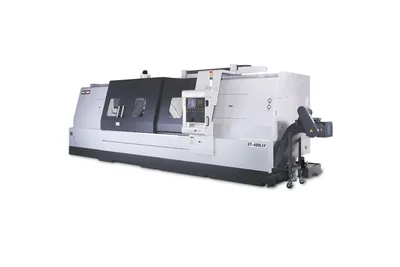
EMAG VL 4
Key Specifications
X Travel
Z Travel
Max Spindle
Spindle Power
Max Workpiece ⌀
max workpiece length
How much does the EMAG VL 4 cost?
Estimated price range
Our best estimate for a cnc lathes / turning center in this class — not a quote from EMAG. Configuration moves it a long way.
Overview
The EMAG VL 4 is a vertical turning machine for chucked parts up to 200 mm (8 in) in diameter and 200 mm (8 in) long, clamped in a 260 mm (10 in) chuck. Its spindle runs to 4,500 rpm with 25 / 18 kW (33.5 / 24 hp) and 280 / 202 Nm (206.5 / 149 ft-lb).
A part as long as it is wide is a common shape for this size class, and the VL 4 gives equal room in both directions. Swing is 280 mm (11 in), so there is clearance above the 200 mm (7.87 in) turning diameter for chuck jaws and part features that stand proud of the turned diameter. Z travel is 415 mm (16.5 in) and X travel is 760 mm (30 in), and both axes rapid at 30 m/min (1,181 ipm).
Tools sit in a 12-station turret with VDI 40 holders. VDI 40 is a heavier holder than a small machine would carry, which suits the torque on offer: 280 Nm is enough for real roughing passes in steel at this diameter. The table does not list driven tools, a Y axis, the control or the machine weight, so confirm those against the job before ordering.
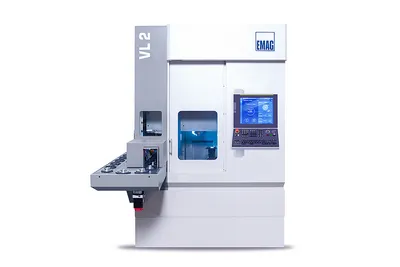
In the VL range the VL 4 is the middle size. The VL 2 below it turns up to 100 mm (3.94 in) at up to 6,000 rpm with 77 / 59 Nm (57 / 43.5 ft-lb). The VL 6 above it turns parts up to 300 mm (12 in) with 460 / 340 Nm (339.5 / 251 ft-lb), but its spindle stops at 3,100 rpm. For parts between those two machines, the VL 4 keeps a useful top speed while adding torque.
Full Specifications
| Parameter | Value |
|---|---|
| Max Workpiece Diameter | 200 mm (8 in) |
| Max Workpiece Length | 200 mm (8 in) |
| Max Spindle Speed | 4,500 rpm |
| Spindle Motor Power | 25 / 18 kW (33.5 / 24 hp) |
| Spindle Torque | 280 / 202 Nm (206.5 / 149 ft-lb) |
| X-Axis Travel | 760 mm (30 in) |
| Z-Axis Travel | 415 mm (16.5 in) |
| Turret Stations | 12 (VDI 40) |
| Chuck Size | 260 mm (10 in) |
| Rapid Traverse X | 30 m/min (1,181 ipm) |
| Rapid Traverse Z | 30 m/min (1,181 ipm) |
| Max Turning Diameter | 200 mm (7.87 in) |
| Max Swing | 280 mm (11 in) |
Specifications sourced from emag.com — verified 2026-10-03
Strengths & Limitations
Strengths
- 280 / 202 Nm (206.5 / 149 ft-lb) of spindle torque for roughing in steel
- Takes parts up to 200 mm (8 in) in diameter and 200 mm (8 in) long
- Rapid traverse of 30 m/min (1,181 ipm) in X and Z
- 12-station turret with VDI 40 tool holders
- 4,500 rpm top speed, against 3,100 rpm on the larger VL 6
Limitations
- The table lists no driven tools or Y axis, so milled features may need another operation
- Top speed of 4,500 rpm is below the 6,000 rpm of the VL 2 for small diameters
- Parts over 200 mm (7.87 in) in diameter need the VL 6
- No control, machine weight or footprint is listed in the table
Best For
Frequently Asked Questions
01
Up to 200 mm (8 in) in diameter and 200 mm (8 in) in length, in a 260 mm (10 in) chuck. Swing is 280 mm (11 in), which leaves room for features larger than the turned diameter.
02
25 / 18 kW (33.5 / 24 hp) and 280 / 202 Nm (206.5 / 149 ft-lb), with a top speed of 4,500 rpm. The table gives both figures as pairs without naming the duty cycle of each, so ask EMAG which rating applies to continuous cutting.
03
760 mm (30 in) in X and 415 mm (16.5 in) in Z. Both axes rapid at 30 m/min (1,181 ipm), so the long X stroke between loading and cutting positions costs little time per part.
04
The VL 6 turns up to 300 mm (12 in) with 460 / 340 Nm (339.5 / 251 ft-lb) and VDI 50 holders, but runs to 3,100 rpm. The VL 4 is the better fit for parts up to 200 mm (7.87 in), where its 4,500 rpm keeps cutting speed up on smaller diameters.
Comparisons
More from EMAG
Other CNC Lathes / Turning Centers
Feeler FVT-1000
Mazak QT-COMPACT 300M
You Ji VTH5000ATC
Tsugami M06J-II
Okuma LT3000 EX