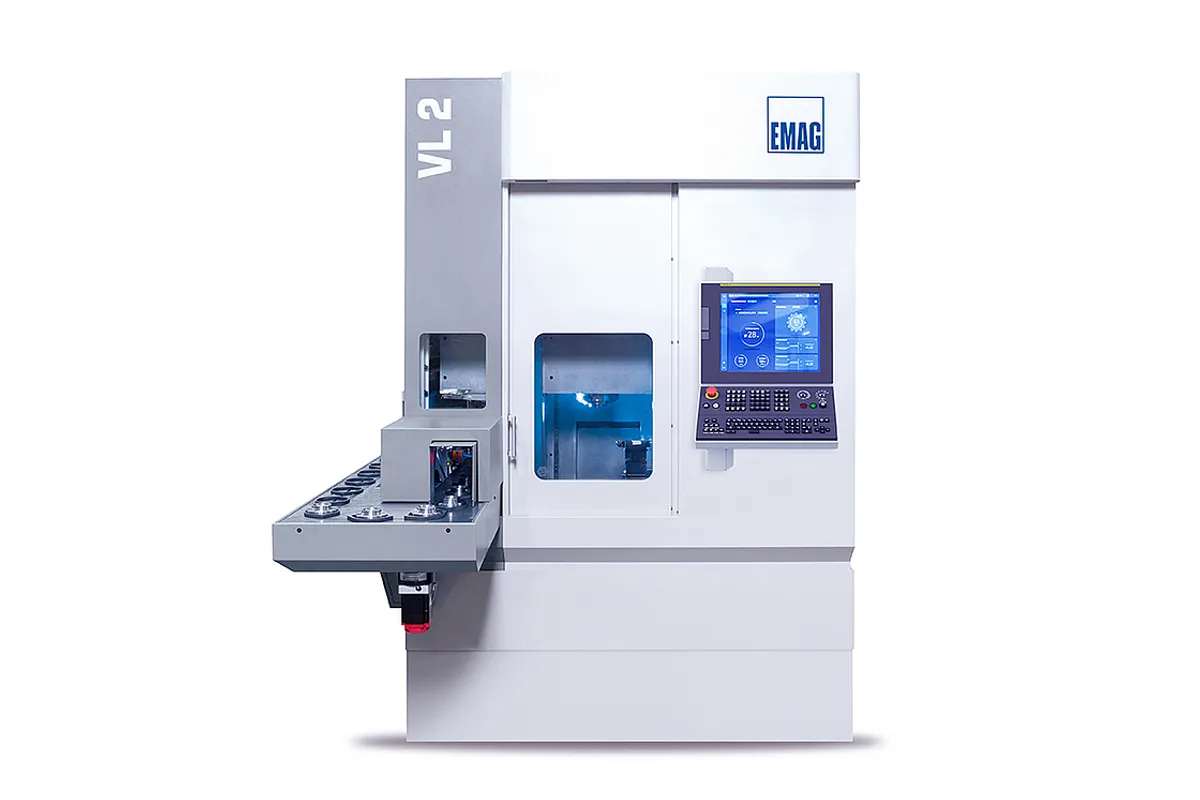
EMAG VL 2
Key Specifications
X Travel
Z Travel
Max Spindle
Spindle Power
Max Workpiece ⌀
Max Turn Length
How much does the EMAG VL 2 cost?
Estimated price range
Our best estimate for a cnc lathes / turning center in this class — not a quote from EMAG. Configuration moves it a long way.
Overview
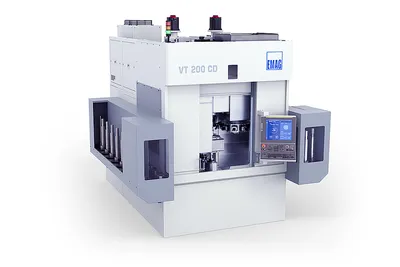
The EMAG VL 2 is the smallest of the current VL vertical turning machines, sized for chucked parts up to 100 mm (4 in) in diameter and 150 mm (6 in) long. It runs a 160 mm (6.5 in) chuck at up to 6,000 rpm, with 18 / 14 kW (24.5 / 18.5 hp) and 77 / 59 Nm (57 / 43.5 ft-lb) from the spindle.
The length figures need reading together. The table gives a maximum rotation length and workpiece length of 150 mm (5.91 in), but a maximum turning length of 110 mm. In practice that means a part up to 150 mm can be loaded and spun, while the turned length on it stays within 110 mm. Check the drawing against the shorter figure.
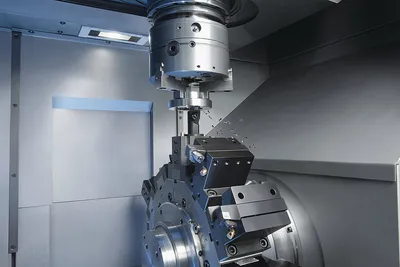
The 12-station turret carries driven tools at 6,000 RPM with 8.5 kW. That is a strong drive for a machine this size, enough for drilling and milling features on small parts in the same clamping. The base machine has X and Z; a Y axis in the turret is optional, so off-centre holes and flats need that option. Travel is 650 mm (25.5 in) in X and 375 mm (15 in) in Z, and swing is 210 mm (8.5 in).
The step up within the range is large. The VL 4 turns up to 200 mm (7.87 in) in a 260 mm (10 in) chuck with 280 / 202 Nm (206.5 / 149 ft-lb), nearly four times the torque, but tops out at 4,500 rpm. On small, light parts the VL 2's higher spindle speed and fast driven tools are the better fit. Against the VLC 100, which shares the 650 mm X travel and 160 mm chuck, the VL 2 lists 12 turret stations to the VLC 100's 8.
Full Specifications
| Parameter | Value |
|---|---|
| Max Turning Diameter | 100 mm (3.94 in) |
| Max Rotation Length | 150 mm (5.91 in) |
| Max Spindle Speed | 6,000 rpm |
| Spindle Motor Power | 18 / 14 kW (24.5 / 18.5 hp) |
| Spindle Torque | 77 / 59 Nm (57 / 43.5 ft-lb) |
| Turret Stations | 12 |
| Turret Driven Tool Speed | 6,000 RPM |
| Turret Driven Tool Power | 8.5 kW |
| Axes | 3 (X, Z, plus optional Y in turret) |
| Max Turning Length | 110 mm |
| Max Workpiece Diameter | 100 mm (4 in) |
| Max Workpiece Length | 150 mm (6 in) |
| Chuck Size | 160 mm (6.5 in) |
| Max Swing | 210 mm (8.5 in) |
| X-Axis Travel | 650 mm (25.5 in) |
| Z-Axis Travel | 375 mm (15 in) |
Specifications sourced from emag.com — verified 2026-10-03
Strengths & Limitations
Strengths
- 6,000 rpm spindle with 18 / 14 kW (24.5 / 18.5 hp) for small diameters
- Driven tools at 6,000 RPM and 8.5 kW in a 12-station turret
- Takes parts up to 150 mm (6 in) long and 100 mm (4 in) in diameter
- 650 mm (25.5 in) of X travel and 375 mm (15 in) of Z
- 12 turret stations, against 8 (VDI 30) on the VLC 100
Limitations
- Turning length is 110 mm, shorter than the 150 mm (6 in) workpiece length
- Turning diameter stops at 100 mm (3.94 in); the VL 4 is needed for parts up to 200 mm (7.87 in)
- The Y axis in the turret is optional; the base machine has X and Z only
- Spindle torque of 77 / 59 Nm (57 / 43.5 ft-lb) limits heavy roughing in steel
Best For
Frequently Asked Questions
01
100 mm (4 in) in diameter and 150 mm (6 in) in length. The maximum turning length is 110 mm, so a part can be up to 150 mm long while the turned section stays within 110 mm. The chuck is 160 mm (6.5 in) and swing is 210 mm (8.5 in).
02
Only as an option. The table lists 3 axes: X and Z, plus an optional Y in the turret. Without it, driven tools can drill and mill on centre only.
03
They run to 6,000 RPM with 8.5 kW, from a 12-station turret. That is enough power for drilling and light milling on the small parts the machine takes.
04
It depends on part size and material. The VL 2 turns up to 100 mm (3.94 in) at up to 6,000 rpm with 77 / 59 Nm (57 / 43.5 ft-lb). The VL 4 turns up to 200 mm (7.87 in) with 280 / 202 Nm (206.5 / 149 ft-lb) but runs to 4,500 rpm.
Comparisons
More from EMAG
Other CNC Lathes / Turning Centers
Hyundai WIA SE2200 (S type)
Citizen Miyano GN-4200
Goodway GA-3600/W24
Honor Seiki VL-500CM
DMG Mori Wasino AA-1