Industrial CNC Machine Directory

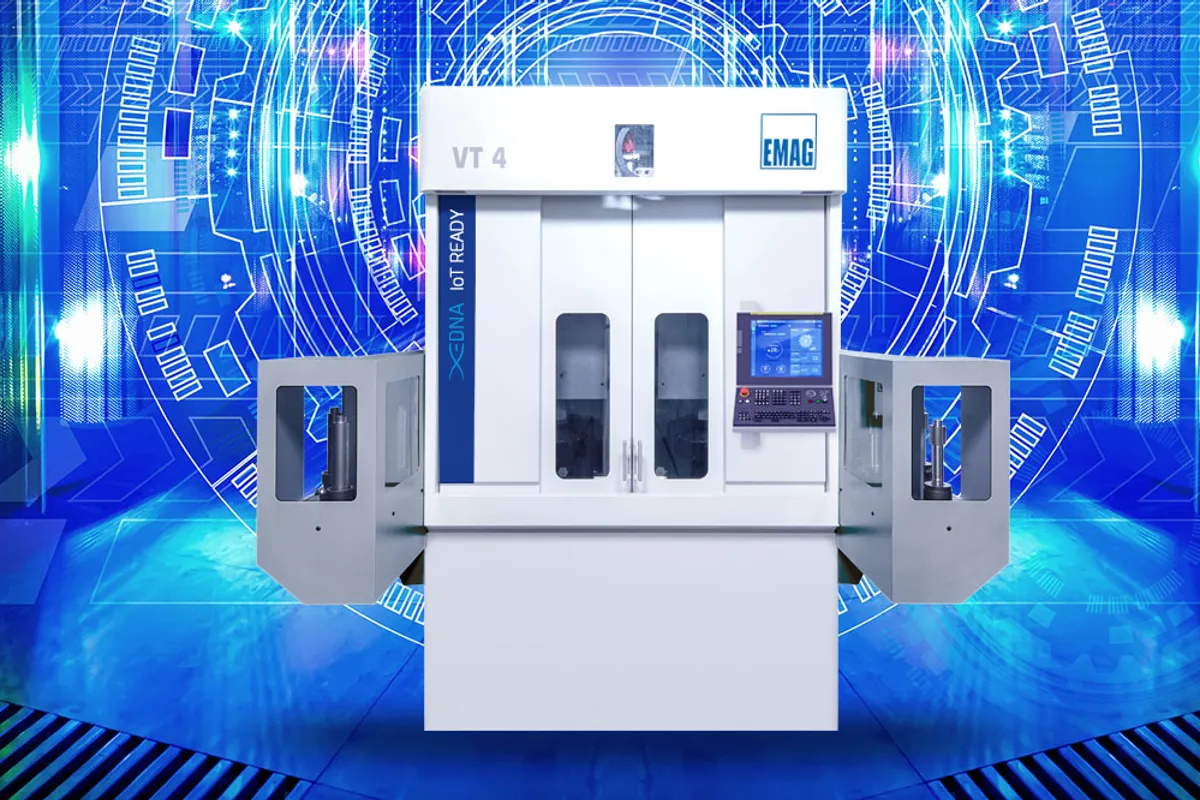
EMAG VT 4

$300,000 - $450,000 Updated 2026-03-15
EMAG VT 4 CNC Lathes
01

Key Specifications

X Travel

270 mm (10.6 in)

Z Travel

480 mm (18.9 in)

max turning diameter

400 mm (15.75 in)

max workpiece length

300 mm (11.8 in)

max workpiece weight

40 kg (88 lb)

chuck size

315 mm (12.4 in)

02

Overview

The EMAG VT 4 is a vertical pick-up turning machine designed for high-volume production of medium-sized shaft and chucked components up to 400 mm (15.75 in) in diameter. EMAG pioneered the vertical pick-up lathe concept, and the VT 4 represents the current generation of this production-proven architecture where the spindle picks up the workpiece from an integrated conveyor, machines it, and deposits the finished part — enabling fully automated production without a separate robot or gantry loader. This self-loading design is the defining feature of EMAG turning machines and the reason they dominate automotive and industrial production lines worldwide.

The VT 4 features a main spindle with 43 kW (58 hp) drive power and speeds up to 3,000 rpm, paired with an integral C-axis for driven tool operations. The machine accommodates workpieces up to 400 mm diameter and 300 mm (11.8 in) in length with a maximum workpiece weight of 40 kg (88 lb). The vertical spindle orientation means gravity assists chip evacuation — chips fall directly into the chip conveyor below, keeping the workpiece and tool zone clean. This design eliminates the chip-nesting problems that plague horizontal lathes in high-volume production.

The turret accommodates 12 tool positions with driven tools for milling, drilling, and tapping operations, enabling complete machining in a single setup. The FANUC 31i-B CNC control provides the programming environment, and EMAG's proprietary TrackMotion automation system can link multiple VT machines into a complete production line where parts flow automatically from OP10 through OP20 and beyond. This line integration capability is what makes EMAG machines the backbone of automotive powertrain production at OEMs and Tier 1 suppliers.

The machine's polymer concrete (Mineralit) base provides excellent thermal stability and vibration damping — 6-8 times better than cast iron — resulting in superior surface finish and longer tool life. The compact footprint of approximately 2,500 x 2,700 mm (98 x 106 in) and the integrated automation eliminate the need for external part handling equipment, making the VT 4 significantly more space-efficient than a comparable horizontal lathe with robot loading.

New EMAG VT 4 machines typically price between $300,000 and $450,000, positioning them against the Weisser Univertor AC-1, Index V160C, and Mori Seiki NVL series in the vertical turning segment.

03

Full Specifications

Parameter Value
Max Turning Diameter 400 mm (15.75 in)
Max Workpiece Length 300 mm (11.8 in)
Max Workpiece Weight 40 kg (88 lb)
Chuck Size 315 mm (12.4 in)
Main Spindle Speed 3,000 rpm
Main Spindle Power 43 kW (58 hp)
Turret Positions 12 (with driven tools)
C Axis Standard
X-Axis Travel 270 mm (10.6 in)
Z-Axis Travel 480 mm (18.9 in)
CNC Control FANUC 31i-B
Machine Base Polymer concrete (Mineralit)
Automation Integrated pick-up spindle with conveyor
Machine Weight Approx. 7,500 kg (16,535 lb)
Floor Space Required 2,500 x 2,700 mm (98.4 x 106.3 in)
Workpiece Dia Max mmin
Workpiece Length Max mmin
Chuck Dia Max mmin
Swing Diameter mmin
Gripper Diameter Max mmin
X Axis Travel mmin
Z Axis Travel mmin
Main Spindle Power Rating At 40 100 Duty Cycle kW ./ hp
Main Spindle Torque At 40 100 Duty Cycle Nm ./ ft-lb
Main Spindle Speed Max rpm

Specifications sourced from emag.com — verified 2026-03-28

04

Strengths & Limitations

Strengths

  • Integrated pick-up spindle automates part handling without external robots, reducing capital cost and floor space versus horizontal lathe + loader combinations
  • Vertical spindle orientation uses gravity for natural chip evacuation, eliminating chip nesting and the resultant surface finish and tool life problems
  • Polymer concrete (Mineralit) base provides 6-8x better vibration damping than cast iron, directly improving surface finish and tool life
  • 43 kW spindle power with 12-position driven tool turret enables complete machining of shafts and chucked parts in a single operation
  • TrackMotion line integration allows multiple VT machines to form automated OP10/OP20/OP30 production lines with automatic part transfer
  • Compact 2,500 x 2,700 mm footprint includes the entire automation system — no external loader, guarding, or conveyor required

Limitations

  • 400 mm max diameter limits the VT 4 to medium-sized parts — larger components like brake rotors and gear blanks require EMAG's VL/VSC series
  • The vertical pick-up architecture is optimized for disc and short shaft parts — long slender shafts require between-centers support not available on this platform
  • EMAG's proprietary automation approach creates vendor lock-in for line expansion — adding machines from other builders to an EMAG line is not straightforward
  • At $300K-$450K per machine, multi-station EMAG lines represent significant capital investment — $1M+ for a typical 3-machine cell
05

Best For

Automotive powertrain production lines machining gear blanks, ring gears, CVJ components, and bearing races in high volume Industrial bearing manufacturers turning inner and outer races at production rates with consistent quality Brake component manufacturers needing automated production of disc brake rotors, drums, and hubs Transmission component suppliers producing synchronizer rings, clutch housings, and planetary gear carriers Any high-volume manufacturer seeking to eliminate manual part handling and maximize spindle utilization on disc-type components
06

Frequently Asked Questions

01 How does the EMAG pick-up spindle system work?

The VT 4's main spindle moves to a pickup position above the part conveyor, lowers, and grips the raw workpiece with its chuck. The spindle then carries the part to the machining position where the turret performs all turning, drilling, and milling operations. After machining, the spindle deposits the finished part back on the conveyor. This entire pick-up, machine, and deposit cycle happens automatically, with the conveyor buffering multiple parts for unattended operation.

02 What is TrackMotion and how does it work with the VT 4?

TrackMotion is EMAG's proprietary automation system that links multiple vertical turning machines into a production line. A track-mounted gripper unit travels between machines, picking finished parts from one machine's conveyor and delivering them to the next machine's input station. This enables automatic OP10-to-OP20 transfer for parts that need machining on both sides. TrackMotion is simpler and more compact than conventional robot-based line automation.

03 How does the EMAG VT 4 compare to the EMAG VL 2?

The VT 4 is designed for shaft-type and larger chucked parts with 400 mm diameter capacity and 43 kW spindle power. The VL 2 targets smaller disc-type parts with 160 mm diameter capacity in a more compact package. Both use the same pick-up spindle concept and can be linked via TrackMotion. Choose the VT 4 for medium-sized powertrain components; choose the VL 2 for smaller parts like bearing races and small gears.

04 Why does EMAG use polymer concrete instead of cast iron?

EMAG's Mineralit polymer concrete base provides 6-8 times better vibration damping than cast iron, which directly translates to better surface finish and longer tool life — critical advantages in high-volume production where every 10% improvement in tool life saves significant annual tooling costs. Polymer concrete also has better thermal stability than cast iron, reducing dimensional drift during long production runs. The material is cast at room temperature, allowing more complex internal geometries for coolant channels and cable routing.

05 What cycle times can the VT 4 achieve?

Cycle times depend entirely on the part complexity and material. Typical automotive applications see 30-90 second cycles for operations like gear blank turning, bearing race machining, and CVJ component turning. The pick-up and deposit sequence adds approximately 6-8 seconds per cycle. For multi-operation parts using TrackMotion lines, the line cycle time is determined by the longest individual station cycle, so balancing operations across stations is critical for throughput optimization.

06 Is the VT 4 suitable for small-batch production?

While the VT 4 can technically handle small batches, its value proposition is strongest in medium to high-volume production where the integrated automation and rapid cycle times are fully utilized. For small-batch work, the pick-up system adds cycle time compared to manual loading a conventional vertical lathe. Shops running fewer than 500 parts per setup may find a standard vertical turning center more cost-effective. The VT 4 shines at 5,000+ parts per month.

07

Videos

EMAG VT 2-4

EMAG VT 2-4

MTDCNC

EMAG VT 2 4  - G+S Werkzeugmaschinen

EMAG VT 2 4 - G+S Werkzeugmaschinen

G+S Werkzeugmaschinen

Emag VL 4 Vertical Pick Up Spindle Lathes

Emag VL 4 Vertical Pick Up Spindle Lathes

Mark Comeaux

EMAG VLF 4 Vertical Lathe

EMAG VLF 4 Vertical Lathe

Surplex

Emag VT2-4 vertical pick up lathe for shaft manufacturing

Emag VT2-4 vertical pick up lathe for shaft manufacturing

Mark Comeaux

08

Community Discussions

09

Related Machines