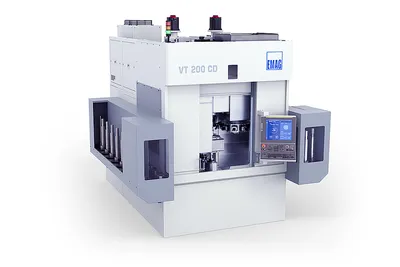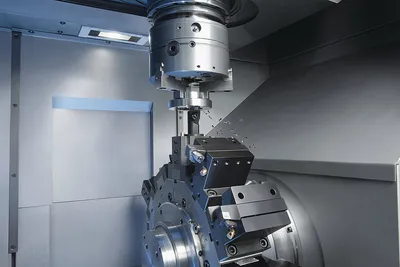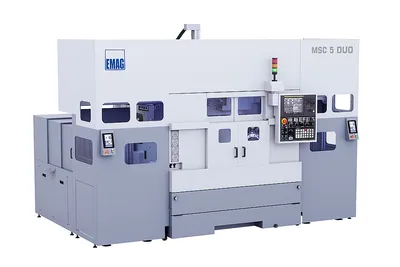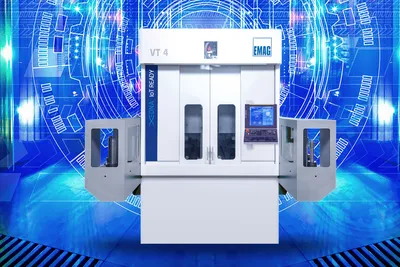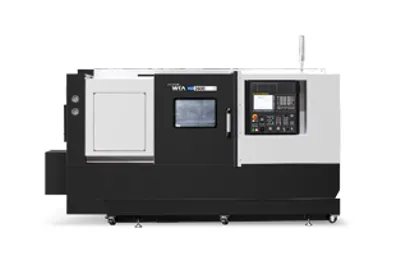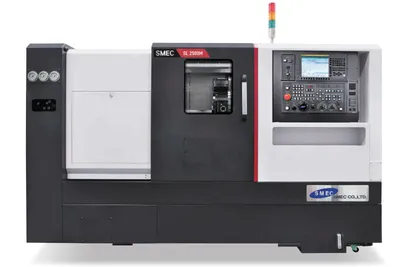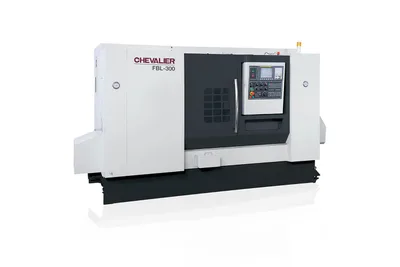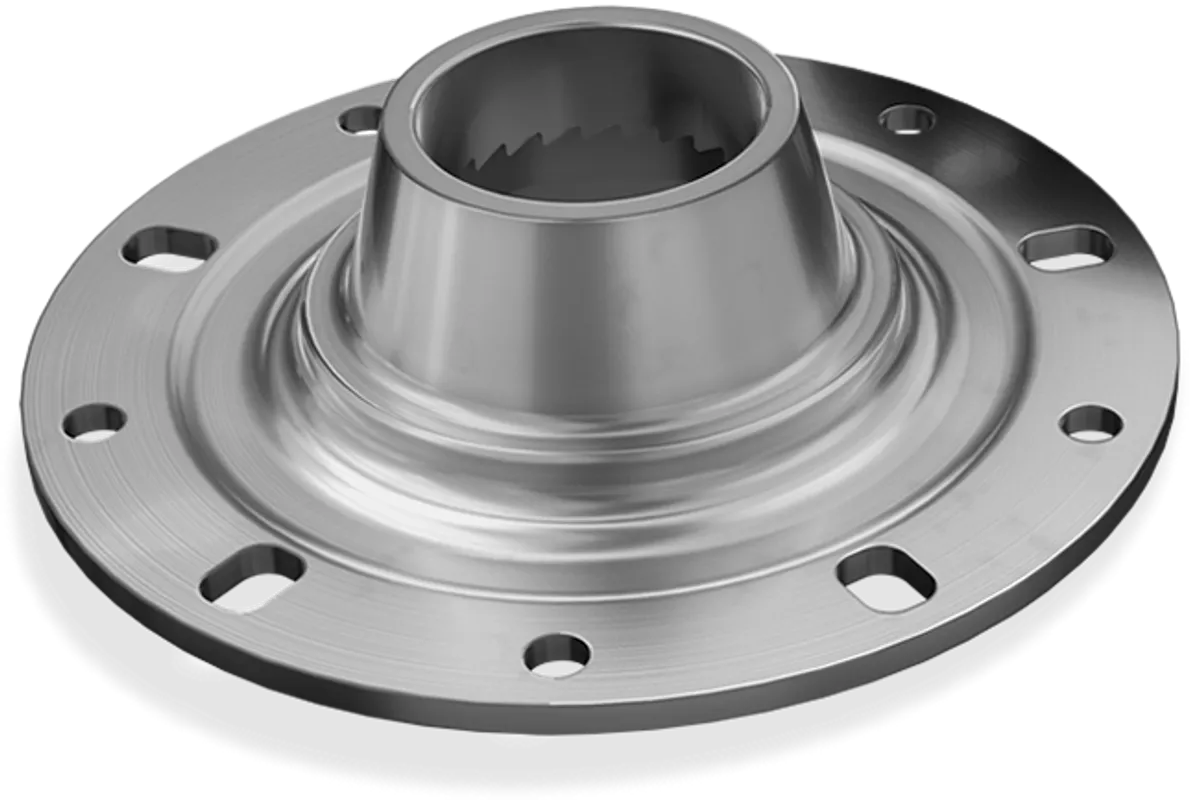
EMAG VL 6
Key Specifications
X Travel
Z Travel
Max Spindle
Spindle Power
Max Workpiece ⌀
max workpiece length
Overview
The EMAG VL 6 is a vertical pick-up turning machine designed for high-volume production of medium-sized chuck-type components up to 300 mm (11.8 in) diameter. Building on the proven VL platform that EMAG pioneered, the VL 6 extends the pick-up turning concept to larger parts including automotive brake rotors, gear blanks, bearing housings, and industrial flanges that exceed the capacity of the VL 4. The integrated workpiece automation — where the inverted spindle picks up raw parts from a conveyor, machines them, and places finished parts back — remains the defining feature that makes VL machines the productivity benchmark for high-volume chuck-type turning.
The main spindle delivers 28 kW (37.5 hp) continuous power with speeds up to 4,500 RPM and a maximum torque of 530 Nm (391 ft-lb). The increased power and torque compared to the VL 4 reflects the larger workpiece sizes and heavier cuts the VL 6 is designed to handle. The spindle nose accommodates a 315 mm (12.4 in) hydraulic chuck, and the vertical orientation ensures chips fall away from the workpiece and machine guideways under gravity — improving surface finish and reducing maintenance intervals.
The 12-position VDI 50 turret provides larger tool shank capacity for the heavier tooling needed when machining larger-diameter parts. X and Z axis travels of 210 mm (8.3 in) and 400 mm (15.7 in) respectively are optimized for the geometries of chuck-type components in the VL 6's size range. Optional driven tools enable light milling, drilling, and tapping operations without secondary operations on a separate machine.
The MINERALIT polymer concrete machine base provides vibration damping 6-8 times better than cast iron, which is particularly beneficial for the VL 6 as larger workpieces amplify vibration effects. The Fanuc 31i control with EMAG's production interface manages the integrated automation including conveyor positioning, spindle pick-up sequencing, and statistical process control. The load-to-load cycle time of approximately 8-10 seconds keeps idle time between parts to a minimum. New VL 6 machines are priced between $300,000 and $400,000, making them cost-competitive against horizontal lathes with separate robot loading when total cell cost is considered.
Full Specifications
| Parameter | Value |
|---|---|
| Max Workpiece Diameter | 300 mm (11.8 in) |
| Max Workpiece Length | 200 mm (7.87 in) |
| Max Spindle Speed | 4,500 RPM |
| Spindle Motor Power | 28 kW (37.5 hp) |
| Spindle Torque | 530 Nm (391 ft-lb) |
| X-Axis Travel | 210 mm (8.3 in) |
| Z-Axis Travel | 400 mm (15.7 in) |
| Turret Stations | 12 (VDI 50) |
| Chuck Size | 315 mm (12.4 in) |
| Rapid Traverse X | 30 m/min (1,181 ipm) |
| Rapid Traverse Z | 30 m/min (1,181 ipm) |
| Machine Base | MINERALIT polymer concrete |
| Workpiece Handling | Integrated pick-up automation with conveyor |
| CNC Control | Fanuc 31i |
| Machine Weight | 7,200 kg (15,873 lb) |
| Floor Space Required | 2,600 x 2,700 mm (102.4 x 106.3 in) |
| Workpiece Dia Max | mmin |
| Workpiece Length Max | mmin |
| Chuck Dia Max | mmin |
| Swing Diameter | mmin |
| X Axis Travel | mmin |
| Y Axis Travel | mmin |
| Z Axis Travel | mmin |
| Main Spindle Power Rating At 40 100 Duty Cycle | kWhp |
| Main Spindle Torque At 40 100 Duty Cycle | Nmft-lb |
| Main Spindle Speed Max | rpm |
Specifications sourced from emag.com — verified 2026-03-28
Strengths & Limitations
Strengths
- Integrated pick-up automation handles parts up to 300 mm diameter without separate robot or gantry loader — fully automated turning in a single machine footprint
- 28 kW spindle with 530 Nm torque provides the cutting power needed for aggressive roughing of medium-sized castings and forgings
- Vertical inverted spindle design ensures gravity-assisted chip evacuation, reducing chip recutting and improving surface finish quality
- MINERALIT polymer concrete base provides exceptional vibration damping — critical for maintaining finish quality on larger-diameter parts where chatter risks increase
- 8-10 second load-to-load cycle time means near-continuous cutting, maximizing spindle utilization for high-volume production
- Modular platform integrates into EMAG production lines with TrackMotion conveyor systems connecting multiple VL machines for multi-operation processing
Limitations
- 300 mm maximum diameter limits the VL 6 to medium-sized chuck parts — larger components require the VL 8 or alternative platform
- Vertical pick-up concept requires parts to be loaded consistently on the conveyor — irregularly shaped workpieces may need custom part carriers
- $300K-$400K pricing is justified only at production volumes — shops running fewer than 50,000 parts per year should evaluate total cost of ownership carefully
- Not designed for shaft-type or long workpieces — the VL platform is exclusively for disc, ring, and short chuck-type parts
- 4,500 RPM maximum spindle speed is lower than many horizontal CNC lathes, limiting surface speed on smaller-diameter finish cuts
Best For
Frequently Asked Questions
01
The VL 6 handles workpieces up to 300 mm diameter versus 200 mm for the VL 4. The VL 6 has a more powerful spindle (28 kW vs 18.1 kW, 530 Nm vs 245 Nm), a larger turret (VDI 50 vs VDI 40), and a larger chuck (315 mm vs 210 mm). Both share the same pick-up automation concept and MINERALIT base construction. For parts in the 200-300 mm range, the VL 6 is the correct choice. For parts under 200 mm, the VL 4 is more cost-effective. The VL 6 costs approximately $50K-$80K more than the VL 4.
02
Yes, hard turning of case-hardened parts up to 62 HRC is a common VL 6 application. The MINERALIT base's vibration damping and the vertical spindle's chip evacuation are both advantageous for hard turning where surface finish quality is critical. Many automotive bearing and gear producers use VL 6 machines for hard turning operations after heat treatment, achieving surface finishes that eliminate the need for subsequent grinding in some applications.
03
Brake rotor turning on the VL 6 typically runs 45-90 seconds machining time per operation, plus 8-10 seconds for the automated load/unload cycle. A complete brake rotor often requires two operations (front and back), so two VL 6 machines connected via TrackMotion can produce a complete rotor every 60-100 seconds. Production rates of 40-60 rotors per hour per line are common in automotive production environments.
04
Yes, production line integration is a core strength of the VL platform. EMAG's TrackMotion linear transport system connects multiple VL machines, VSC grinding machines, and other EMAG platforms for sequential multi-operation processing. A typical line might include a VL 6 for soft turning OP10, a second VL 6 for OP20, and a VLC grinding machine for finish grinding. The TrackMotion system handles part transfer, orientation, and buffering between stations automatically.
Videos
EMAGLLC
Surplex
EMAG
SME Media
Surplex
Community Discussions
Pricing and buying discussion — Any Fellow Emag VL5 owners out there? - Practical Machinist
Community discussion — Strange auction: Hardinge EMAG VL-5 ...
Electrical and installation requirements — Build Thread hardinge Emag VL3 Manuals - CNCzone
Community discussion — Need Help! how to load a program in fanuc 6t? - CNCzone
Troubleshooting and problem-solving — Need Help! 751 spindle alarm (AL-30) - CNCzone
Community discussion — Emag VL5, PMC password? - cnczone.com
Community discussion — CAPTO alternatives? : r/Machinists - Reddit
Community discussion — Recommendations for CNC VMC : r/Machinists - Reddit
Community discussion — What does everyone see as the most trusted CNC ... - Reddit
Troubleshooting and problem-solving — Need Help with Vevor Lathe Decision : r/Machinists - Reddit
Links to community discussions. Summaries are editorial — visit the original thread for full context.