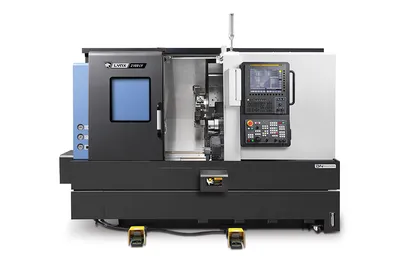
DN Solutions LYNX 2100 LMC
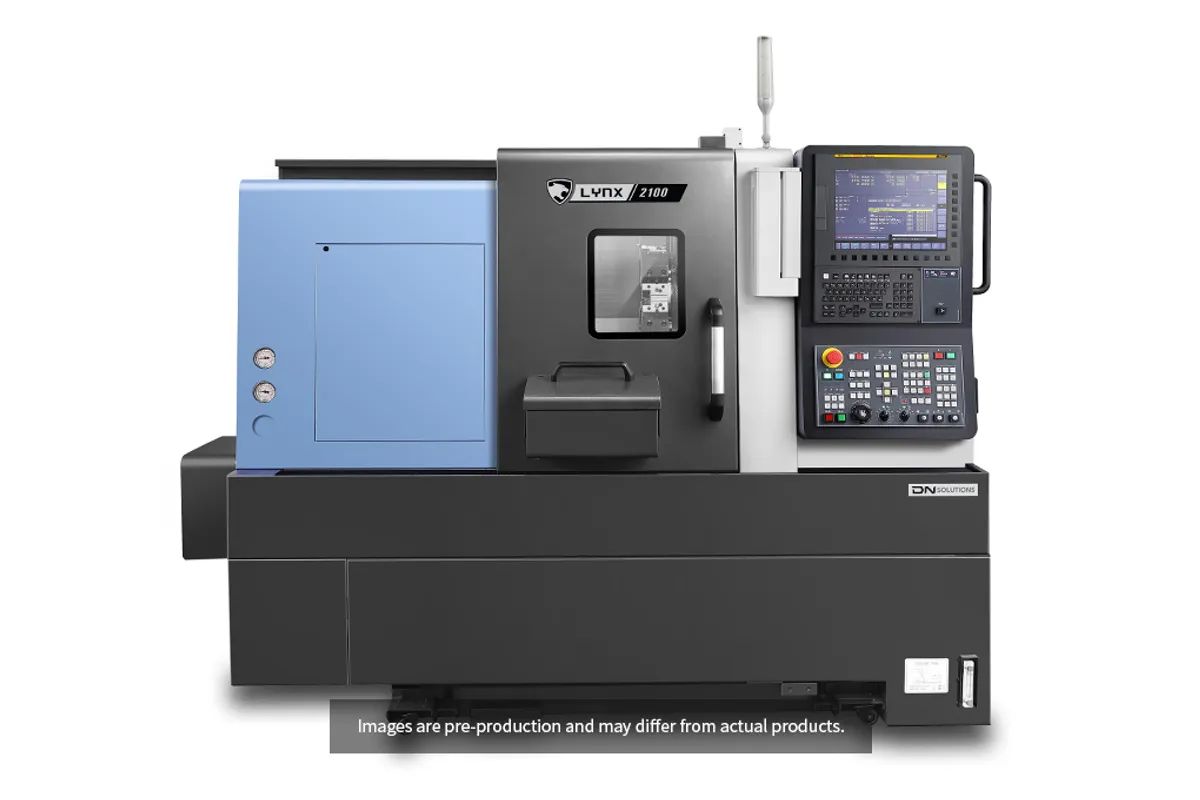
Image: dn-solutions.com, DN Solutions
Key Specifications
X Travel
Z Travel
Max Spindle
Spindle Power
Max Turn Length
chuck size
How much does the DN Solutions LYNX 2100 LMC cost?
Estimated price range
Our best estimate for a cnc lathes / turning center in this class — not a quote from DN Solutions. Configuration moves it a long way.
Overview
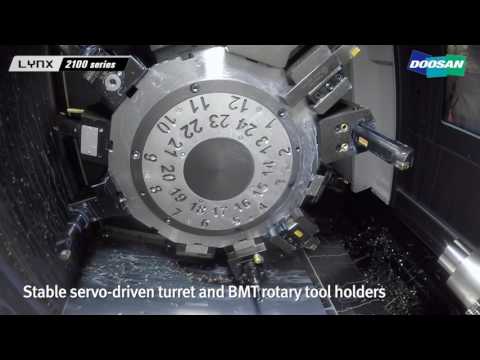
The DN Solutions LYNX 2100 LMC puts live tooling on the 10 in version of the LYNX 2100 frame: 18.5 kW (25 hp), 269 N·m (198 ft-lb) and 3,500 rpm at the spindle, plus driven tools at 6,000 rpm. Maximum turning diameter is 300 mm (12 in) and maximum turning length is 497 mm (20 in).
One relationship in those figures deserves attention. A 10 in chuck is close in size to the 300 mm (12 in) turning limit, so this is not a machine where a small chuck spins a much larger blank. It is a machine for parts that nearly fill the chuck: thick rings, short heavy shafts, housings. The spindle is sized to match. Compared with the 15 kW (20 hp), 127 N·m (94 ft-lb) spindle of the 6 in LYNX 2100 LA, it has about 23% more power and roughly 2.1 times the torque.
Speed goes the other way. 3,500 rpm is fine for the diameters a 10 in chuck grips and poor for small bar-size parts, which belong on a 6,000 rpm variant. The live tools are independent of that limit and reach 6,000 rpm, so small drills and end mills still run at a sensible speed on a big part. Their power and torque are not in DN Solutions' table, and no Y travel is listed.
Buyers who want this spindle power with more torque and a Y axis can look one size up. The LYNX 2600 Y is also a 10 in, 18.5 kW (25 hp), 3,500 rpm machine, but it delivers 403 N·m (297 ft-lb), has 105 mm (4 in) of Y travel and weighs 5,750 kg (12,677 lb). The LYNX 2100 LMC weighs 3,500 kg (7,716 lb) and measures 2,570 × 1,602 × 1,693 mm (101 × 63 × 67 in) as length, width and height. Travels are 205 mm (8 in) in X and 560 mm (22 in) in Z, and the turret has 12 stations.
Full Specifications
| Parameter | Value |
|---|---|
| Chuck Size | 10 in |
| Max Turning Diameter | 300 mm (12 in) |
| Max Turning Length | 497 mm (20 in) |
| Rapid Traverse X | 30 m/min (1,181 ipm) |
| Rapid Traverse Z | 36 m/min (1,417 ipm) |
| X-Axis Travel | 205 mm (8 in) |
| Z-Axis Travel | 560 mm (22 in) |
| Max Spindle Speed | 3,500 rpm |
| Spindle Motor Power | 18.5 kW (25 hp) |
| Spindle Torque | 269 N·m (198 ft-lb) |
| Turret Stations | 12 |
| Live Tool Speed | 6,000 rpm |
| Floor Space Required | 2,570 × 1,602 × 1,693 mm (101 × 63 × 67 in) |
| Machine Weight | 3,500 kg (7,716 lb) |
Specifications sourced from dn-solutions.com — verified 2026-10-02
Strengths & Limitations
Strengths
- 18.5 kW (25 hp) and 269 N·m (198 ft-lb), roughly 2.1 times the torque of the 6 in LYNX 2100 LA
- 10 in chuck for parts close to the 300 mm (12 in) turning limit
- Live tools reach 6,000 rpm although the main spindle stops at 3,500 rpm
- 12 turret stations to divide between turning tools and driven tools
- At 3,500 kg (7,716 lb) it is far lighter than the LYNX 2600 Y, which weighs 5,750 kg (12,677 lb) with the same 18.5 kW (25 hp) rating
Limitations
- 3,500 rpm at the spindle makes small-diameter work slow; the LYNX 2100 LA runs to 6,000 rpm
- Turning length is 497 mm (20 in) on 560 mm (22 in) of Z travel; the LYNX 2100 LA turns 550 mm (22 in)
- No Y travel is listed; the LYNX 2600 Y offers 105 mm (4 in)
- Live-tool power and torque are absent from the table
- Torque is about a third below the 403 N·m (297 ft-lb) of the LYNX 2600 Y
Best For
Frequently Asked Questions
01
DN Solutions lists 18.5 kW (25 hp) and 269 N·m (198 ft-lb) with a top speed of 3,500 rpm. Among the comparison models, the 6 in LYNX 2100 A and LA have 15 kW (20 hp) and 127 N·m (94 ft-lb), and the 8 in LYNX 2100 B has 15 kW (20 hp) and 169 N·m (125 ft-lb). The larger LYNX 2600 Y has the same power and 403 N·m (297 ft-lb).
02
Parts that need a 10 in chuck and stay within 300 mm (12 in) in diameter and 497 mm (20 in) in length. Because the chuck is close to the turning limit, the machine fits work that nearly fills the chuck. Very small parts are a poor match for a 3,500 rpm spindle.
03
It has live tools, listed at 6,000 rpm. It has no Y travel in the table: the axes are X, 205 mm (8 in), and Z, 560 mm (22 in). The LYNX 2600 Y is the comparison model that lists Y travel, 105 mm (4 in), with the same 6,000 rpm live-tool speed.
04
Both have a 10 in chuck, 18.5 kW (25 hp) and 3,500 rpm. The LYNX 2600 Y has 403 N·m (297 ft-lb), turns 380 mm (15 in) by 610 mm (24 in), adds 105 mm (4 in) of Y travel and weighs 5,750 kg (12,677 lb). The LYNX 2100 LMC has 269 N·m (198 ft-lb), turns 300 mm (12 in) by 497 mm (20 in) and weighs 3,500 kg (7,716 lb). Choose on torque, Y-axis need and floor loading.
05
It is 2,570 mm (101 in) long, 1,602 mm (63 in) wide and 1,693 mm (67 in) high, and weighs 3,500 kg (7,716 lb). DN Solutions' series description places the chip conveyor at the rear, so keep that side accessible when planning the layout.
Videos
Mills CNC Limited

Euromarket Group
More from DN Solutions
Other CNC Lathes / Turning Centers
Johnford VTC-6000ATC
YCM TC-46/2300
Accuway UT-360LM
Johnford ST-40CH
DMG Mori CTX 350