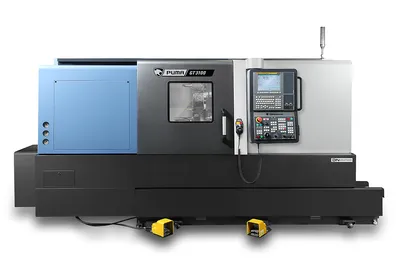
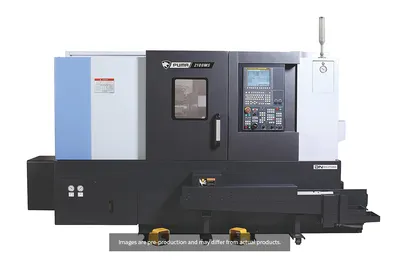
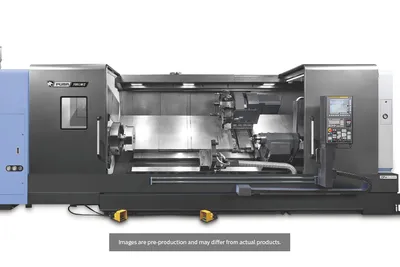
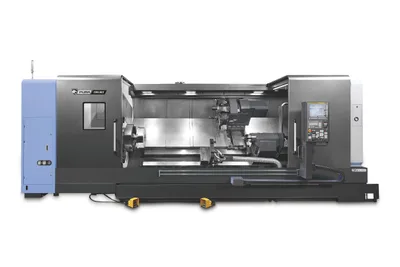
DN Solutions LYNX 2100 G
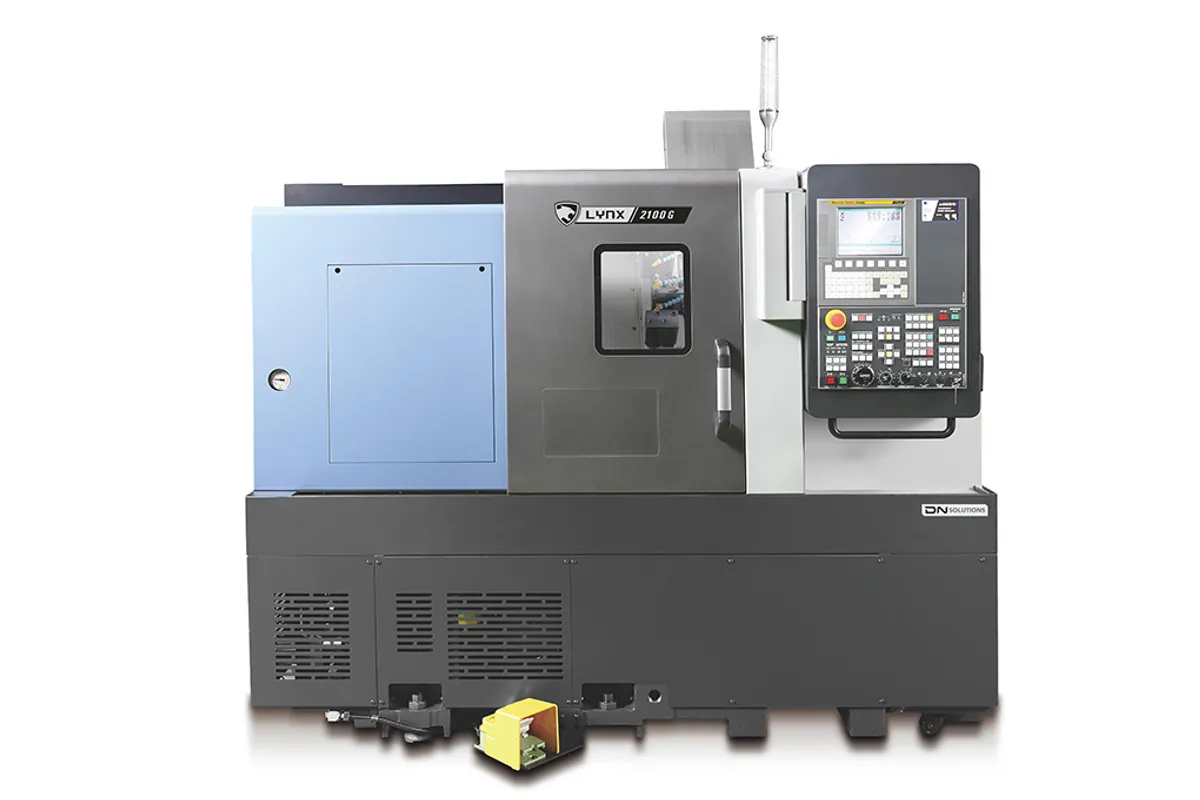
Image: awsimg.dn-solutions.com, DN Solutions
Key Specifications
X Travel
Z Travel
Max Spindle
Spindle Power
Max Turn Length
chuck size
How much does the DN Solutions LYNX 2100 G cost?
Estimated price range
Our best estimate for a cnc lathes / turning center in this class — not a quote from DN Solutions. Configuration moves it a long way.
Overview
The DN Solutions LYNX 2100G is a gang-type lathe. In place of an indexing turret, DN's table gives it 450 mm (18 in) of X travel, on a machine that turns only 170 mm in diameter and 330 mm (13 in) in length. The spindle carries a 6 in chuck and runs to 6,000 rpm with 18.5 kW (25 hp) and 118 N·m (87 ft-lb).
The long cross stroke is what a gang layout requires. Tools stand in a row on the cross slide and the machine changes tool by travelling in X, with no indexing, so the stroke has to span the whole row. The turret-type LYNX 2100 A has 205 mm (8 in) of X travel and a 12-station turret; the LYNX 2100G has more than double that stroke and no turret row in its table. The gain is very short tool-to-tool time on small parts with few tools. The limit is diameter. The LYNX 2100 A turns 350 mm (14 in), about twice the 170 mm listed here. A gang slide has to keep the part clear of the neighbouring tools, which is the usual reason for the smaller figure.
DN fits a larger motor than on the turret machines: 18.5 kW (25 hp) against the 15 kW (20 hp) of the LYNX 2100 A. Listed torque is slightly lower, 118 N·m (87 ft-lb) against the 127 N·m (94 ft-lb) of the LYNX 2100 A, so the extra power is there for speed and acceleration on small work, not for heavier cuts. Rapids are 30 m/min (1,181 ipm) on X and 36 m/min (1,417 ipm) on Z, and Z travel is 340 mm (13 in).
The machine is small: 2,090 × 1,400 × 1,935 mm (82 × 55 × 76 in) in length, width and height, and 2,900 kg (6,393 lb). DN lists roller-type LM guideways and a grease lubrication system, and describes the design as automation ready. The table does not say how many tools the gang slide holds, so get the tool plate layout from DN and check it against the longest tool list.
Full Specifications
| Parameter | Value |
|---|---|
| Chuck Size | 6 in |
| Max Turning Diameter | 170 mm |
| Max Turning Length | 330 mm (13 in) |
| Rapid Traverse X | 30 m/min (1,181 ipm) |
| Rapid Traverse Z | 36 m/min (1,417 ipm) |
| X-Axis Travel | 450 mm (18 in) |
| Z-Axis Travel | 340 mm (13 in) |
| Max Spindle Speed | 6,000 rpm |
| Spindle Motor Power | 18.5 kW (25 hp) |
| Spindle Torque | 118 N·m (87 ft-lb) |
| Floor Space Required | 2,090 × 1,400 × 1,935 mm (82 × 55 × 76 in) |
| Machine Weight | 2,900 kg (6,393 lb) |
Specifications sourced from dn-solutions.com — verified 2026-10-02
Strengths & Limitations
Strengths
- 450 mm (18 in) of X travel for a row of gang tools, more than double the 205 mm (8 in) of the LYNX 2100 A
- 18.5 kW (25 hp) spindle motor with a 6,000 rpm top speed
- Compact at 2,090 mm (82 in) long and 1,400 mm (55 in) wide, weighing 2,900 kg (6,393 lb)
- Roller-type LM guideways and a grease lubrication system are listed by DN
- No turret indexing between tools, which shortens cycles on small parts
Limitations
- Maximum turning diameter is 170 mm, against 350 mm (14 in) on the LYNX 2100 A
- The table gives no tool count for the gang slide
- 118 N·m (87 ft-lb) of torque is below the 127 N·m (94 ft-lb) of the LYNX 2100 A despite the larger motor
- No rotary tool, Y-axis or sub-spindle row is listed
Best For
Frequently Asked Questions
01
DN describes the LYNX 2100G as a gang type compact turning center. The tools are fixed side by side on the cross slide and the machine moves in X from one to the next, which is why its X travel is 450 mm (18 in). Its table has no turret station row, unlike the LYNX 2100 A with its 12-station turret.
02
Up to 170 mm in diameter and 330 mm (13 in) in length, held in a 6 in chuck, with 340 mm (13 in) of Z travel. That diameter is about half the 350 mm (14 in) of the LYNX 2100 A, so check the largest blank, not just the finished part.
03
In motor power, yes: 18.5 kW (25 hp) against 15 kW (20 hp) for the LYNX 2100 A, both at 6,000 rpm. In torque, no: 118 N·m (87 ft-lb) against the 127 N·m (94 ft-lb) of the LYNX 2100 A. Expect the difference to show in spindle acceleration and high-speed cutting of small diameters.
04
DN lists 2,090 × 1,400 × 1,935 mm (82 × 55 × 76 in) as length, width and height, and 2,900 kg (6,393 lb). The LYNX 2100 A weighs 3,100 kg (6,834 lb). DN's own description stresses the reduced footprint and efficient use of space.
05
DN's table does not state a tool count for this model. On a gang lathe the number depends on the tool plate and on how much clearance each tool needs within the 450 mm (18 in) of X travel, so ask DN for the tool plate layout and compare it with the parts to be run.
Videos
Mills CNC Limited

Mills CNC

Duroc Machine Tool Group

Duroc Machine Tool Group