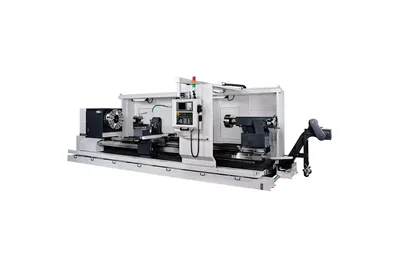
DMG Mori NZX 2000
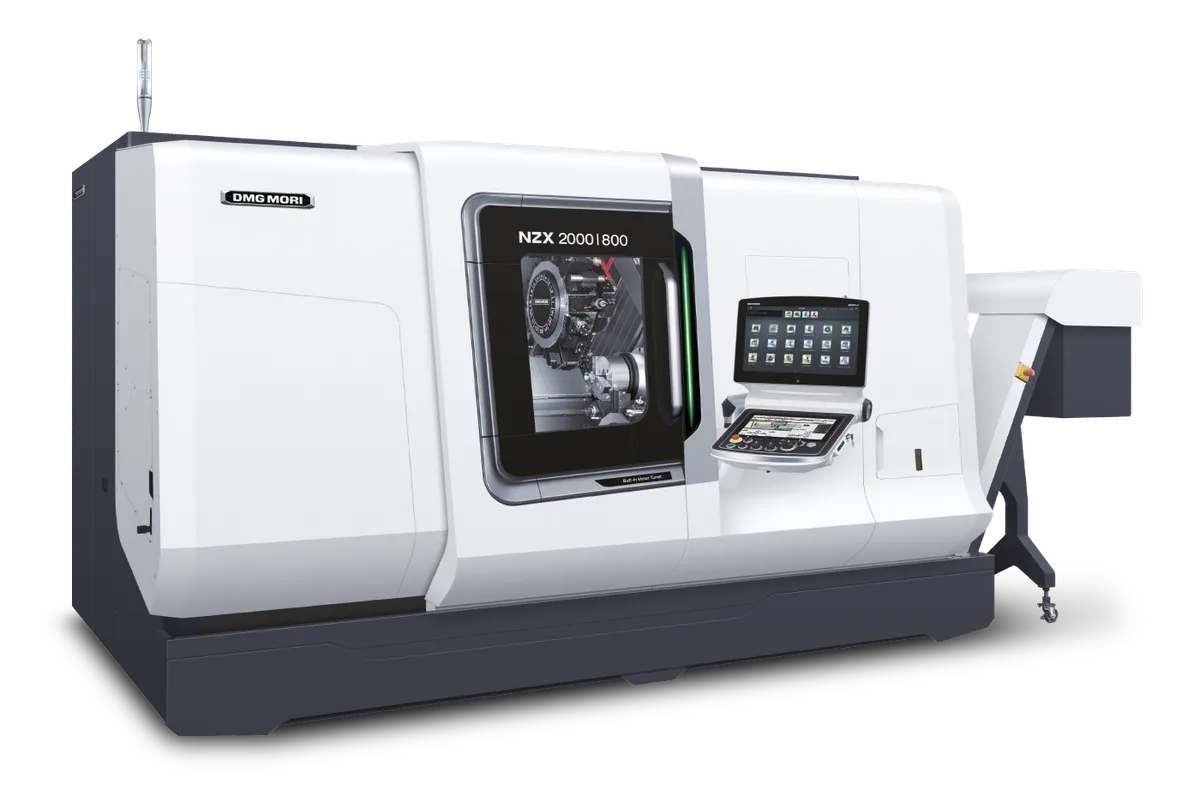
Image: dmgmori.com, DMG Mori
Key Specifications
X Travel
Y Travel
Z Travel
Tool Capacity
Rapid Traverse
Max Workpiece ⌀
How much does the DMG Mori NZX 2000 cost?
Estimated price range
Our best estimate for a cnc lathes / turning center in this class — not a quote from DMG Mori. Configuration moves it a long way.
Overview
With a 65 mm (2.6 in) bar capacity and room for workpieces up to 320 mm (12.6 in) in diameter, the DMG MORI NZX 2000 is a production turning center with BMT turrets and a Y-axis. Maximum workpiece length is 810 mm (31.9 in).
Its strokes are 210 mm (8.3 in) in X, 110 mm (4.3 in) in Y and 810 mm (31.9 in) in Z. Z is close to four times X, the proportion of a shaft machine, and the Z stroke equals the longest part the table allows. On work near that limit, check tool reach at both ends of the part on a layout drawing before committing the job.
Milling is a large part of what the turrets are for. Each one takes up to 16 tools, and DMG MORI gives the milling speed as 6,000 rpm in standard form and up to 12,000 rpm with BMT. For a shop running small cutters in non-ferrous bar that difference decides cycle time, so it belongs on the quotation as a line of its own.
Off-centre work runs on a Y-axis that DMG MORI attributes to Turret 2 and builds as an octagonal ram, under the name ORC (Octagonal Ram Construction). That turret also has a turtleneck form so that chips do not collect on it. The rapids are uneven: 164.1 fpm in Z, 98.4 fpm in X and 65.6 fpm in Y. Scale feedback, described as high-resolution direct scale feedback, is an option.
The NZX 1500 shares all three travels, 210 mm (8.3 in), 110 mm (4.3 in) and 810 mm (31.9 in). Against the CLX 350, with 242.5 mm (9.5 in) of X, 80 mm (3.1 in) of Y and 540 mm (21.3 in) of Z, the NZX 2000 gives up some X stroke and gains Y and a much longer Z.
Full Specifications
| Parameter | Value |
|---|---|
| X-Axis Travel | 210 mm (8.3 in) |
| Y-Axis Travel | 110 mm (4.3 in) |
| Z-Axis Travel | 810 mm (31.9 in) |
| Max Workpiece Diameter | 320 mm (12.6 in) |
| Max Workpiece Length | 810 mm (31.9 in) |
| Max Bar Capacity | 65 mm (2.6 in) |
| Driven Tool Speed | Up to 12,000 rpm (standard: 6,000 rpm) |
| Tool Capacity | Up to 16 tools on each turret |
| Rapid Traverse Rate | X / Y / Z: 98.4 / 65.6 / 164.1 fpm |
| Scale Feedback | High-resolution direct scale feedback (option) |
Specifications sourced from dmgmori.com — verified 2026-10-02
Strengths & Limitations
Strengths
- 65 mm (2.6 in) bar capacity with a 320 mm (12.6 in) maximum workpiece diameter
- Each BMT turret takes up to 16 tools
- Rotary tools run at up to 12,000 rpm, with 6,000 rpm standard
- Z rapid traverse of 164.1 fpm along an 810 mm (31.9 in) stroke
- Octagonal ram (ORC) Y-axis on Turret 2, with 110 mm (4.3 in) of Y travel in the table
Limitations
- Z travel and maximum workpiece length are both 810 mm (31.9 in), so full-length parts leave no spare stroke
- 6,000 rpm is the standard milling speed; the 12,000 rpm figure is an upper limit, not the standard machine
- Direct scale feedback is listed as an option
- X travel of 210 mm (8.3 in) is shorter than the 242.5 mm (9.5 in) of the CLX 350
Best For
Frequently Asked Questions
01
65 mm (2.6 in). The maximum workpiece diameter is 320 mm (12.6 in), so anything between the bar capacity and that limit is loaded as a chucked blank. Maximum workpiece length is 810 mm (31.9 in).
02
DMG MORI gives 98.4 fpm for the X-axis, 65.6 fpm for the Y-axis and 164.1 fpm for the Z-axis. Z is the fastest axis and also the longest at 810 mm (31.9 in), which is where most of the non-cutting travel on a shaft part takes place.
03
Not in axis travel. Both are listed with 210 mm (8.3 in) of X, 110 mm (4.3 in) of Y and 810 mm (31.9 in) of Z. The NZX 2000 is rated for workpieces up to 320 mm (12.6 in) in diameter with a 65 mm (2.6 in) bar capacity, and those are the limits to compare with the NZX 1500.
04
The turrets use BMT, which DMG MORI says enables milling at speeds of up to 12,000 rpm; the standard speed is 6,000 rpm. Up to 16 tools can be mounted on each turret. With 110 mm (4.3 in) of Y travel, flats, keyways and off-centre holes within that stroke can be machined without moving the part to a second machine.
05
No. DMG MORI lists high-resolution direct scale feedback as an option. If the work depends on holding diameters over long unattended runs, include it in the quotation and ask what feedback the base machine uses, which DMG MORI does not state.
Videos

GINDUMAC GmbH
Community Discussions
Owner experience and review
Troubleshooting and problem-solving
Links to community discussions. Summaries are editorial — visit the original thread for full context.
More from DMG Mori
Other CNC Lathes / Turning Centers
HNK NT-16/20F
Haas ST-25L
Republic Lagun UTC-1640

Nakamura-Tome NEW TW-30