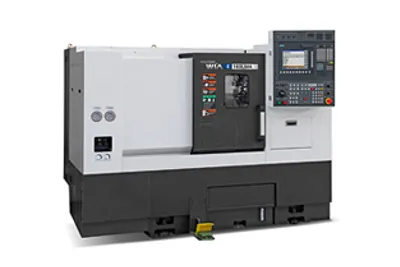
Citizen Miyano BNA-42DHY3
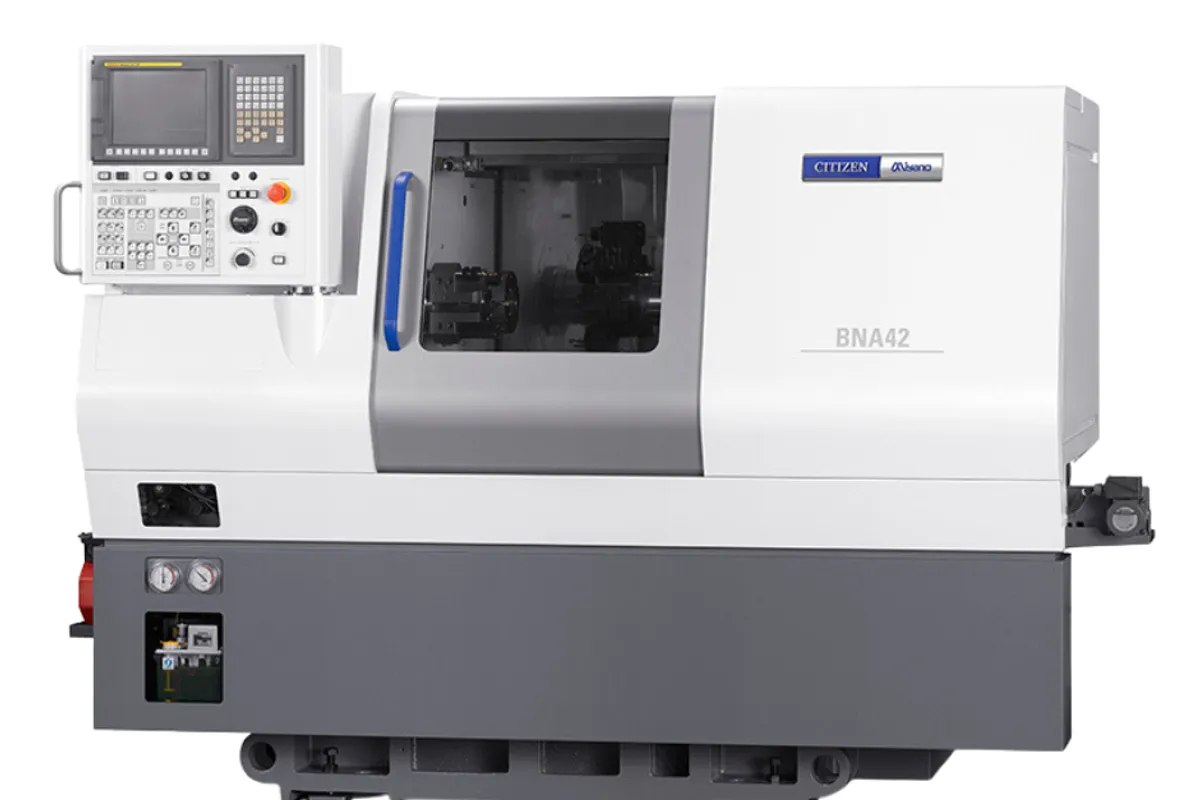
Image: marucit.com, Citizen Machinery
Key Specifications
machining capacity and chuck system maximum machining diamet
machining capacity and chuck system maximum machining length
machining capacity and chuck system power chuck sp1 sp2
machining capacity and chuck system collet chuck type sp1 sp
spindle spindle nose sp1 sp2
spindle spindle motor 15min rating cont sp1
How much does the Citizen Miyano BNA-42DHY3 cost?
Estimated price range
Our best estimate for a cnc lathes / turning center in this class — not a quote from Citizen Machinery. Configuration moves it a long way.
Overview
The Citizen Miyano BNA-42DHY3 is a compact fixed-headstock bar lathe with two spindles and two turrets: an eight-station turret serving the main spindle (SP1) and a six-station turret serving the back spindle (SP2). SP1 takes bar to 42 mm dia. and runs 60 - 6,000 rpm; SP2 handles 34 mm dia. at 50 - 5,000 rpm. Maximum machining length is 100 mm, so this is a machine for short turned parts finished on both ends.
Having a turret on each spindle is what separates it from the single-turret Miyano BNA-42MSY2. Front and back operations can run at the same time instead of queuing for one tool post, which shortens the cycle on parts with real back-end work. The SP1 turret carries a Y axis of 70 mm(±35) for off-centre drilling and milling. Strokes are 140 mm in X1 and 235 mm in Z1; the second slide has 140 mm in X2 and a longer 360 mm in Z2.
Spindle motors are modest. SP1 is rated 7.5 kW for 15 min and 5.5 kW continuous, SP2 5.5 kW and 3.7 kW. Up to 8 revolving tools can be fitted, running 50 - 5,000 rpm on a 2.8/1.0 kW motor, which is enough for cross holes, flats and tapping on small parts rather than heavy milling. The turrets index in 0.2Sec./1St. using an AC servo motor and curvic coupling, and take 20 mm Sq. turning tools and 25 mm dia. drill shanks.
Power chucks are 5" on SP1 and 4" on SP2, with a special flat spindle nose. The machine needs a floor area of 2,350×1,450 mm, stands 1,700 mm high and weighs 3,100 kg, small enough to run several side by side in a cell.
Full Specifications
| Parameter | Value |
|---|---|
| Machining Capacity and Chuck System Maximum Machining Diamet | 42 mm dia./34 mm dia. |
| Machining Capacity and Chuck System Maximum Machining Length | 100 mm |
| Machining Capacity and Chuck System Power Chuck Sp1 Sp2 | 5"/4" |
| Machining Capacity and Chuck System Collet Chuck Type Sp1 Sp | Stationary |
| Spindle Spindle Nose Sp1 Sp2 | Special Flat Type |
| Spindle Spindle Motor 15min Rating Cont Sp1 | 7.5/5.5 kW |
| Spindle Spindle Motor 15min Rating Cont Sp2 | 5.5/3.7 kW |
| Spindle Spindle Speed Range Sp1 | 60 - 6,000 rpm |
| Spindle Spindle Speed Range Sp2 | 50 - 5,000 rpm |
| Turret Type of Turret Sp1 | 8St.Turret |
| Turret Type of Turret Sp2 | 6St.Turret |
| Turret Shank Height of Square Turning Tool | 20 mm Sq. |
| Turret Diameter of Drill Shank | 25 mm dia. |
| Turret Turret Indexing Clamp Method | AC Servo motor & curvic coupling |
| Turret Slide Stroke X1 Axis | 140 mm |
| Turret Slide Stroke Z1 Axis | 235 mm |
| Turret Slide Stroke Y Axis | 70 mm(±35) |
| Turret Slide Stroke X2 Axis | 140 mm |
| Turret Slide Stroke Z2 Axis | 360 mm |
| Turret Indexing Time | 0.2Sec./1St. |
| Revolving Tools Maximum Number of Revolving Tools Sp1 Sp2 | 8 |
| Revolving Tools Tool Spindle Speed Range | 50 - 5,000 rpm |
| Revolving Tools Revolving Tool Motor | 2.8/1.0 kW |
| Machine Dimensions Machine Height | 1,700 mm |
| Machine Dimensions Floor Space | 2,350×1,450 mm |
| Machine Dimensions Machine Weight | 3,100 kg |
Specifications sourced from cmj.citizen.co.jp — verified 2026-10-03
Strengths & Limitations
Strengths
- Two turrets, eight-station on SP1 and six-station on SP2, so front and back operations can overlap
- Y axis of 70 mm(±35) on the SP1 turret for off-centre drilling and milling
- Turret indexing of 0.2Sec./1St. with AC servo drive and curvic coupling
- Long 360 mm Z2 stroke on the back-spindle side for back-end work and part transfer
- Compact 2,350×1,450 mm floor space and 3,100 kg weight for cell layouts
Limitations
- Maximum machining length is 100 mm, which limits the machine to short parts
- SP2 bar capacity drops to 34 mm dia. against 42 mm dia. on SP1
- SP1 motor is rated 7.5 kW for 15 min and 5.5 kW continuous, lower than the 11/7.5 kW of the Miyano BNA-42MSY2
- No more than 8 revolving tools, on a 2.8/1.0 kW motor, so milling content has to stay light
Best For
Frequently Asked Questions
01
The BNA-42DHY3 has two turrets, an eight-station for SP1 and a six-station for SP2, so both spindles can be cut at once. The Miyano BNA-42MSY2 has a single 8-station turret with a half-indexing mechanism but a stronger 11/7.5 kW SP1 motor. Both take 42 mm dia. bar on SP1 and 34 mm dia. on SP2, with 100 mm maximum machining length.
02
SP1 machines bar up to 42 mm dia. and SP2 up to 34 mm dia. Power chucks are 5" on SP1 and 4" on SP2. A part whose back end is larger than 34 mm dia. cannot be gripped on SP2 for back working.
03
X1 is 140 mm and Z1 235 mm on the SP1 turret slide, which also has a Y axis of 70 mm(±35). The second slide has 140 mm in X2 and 360 mm in Z2.
04
Up to 8 revolving tools, at 50 - 5,000 rpm, driven by a 2.8/1.0 kW motor. Turning tools are 20 mm Sq. and drill shanks 25 mm dia. That suits cross holes, small flats and tapping on bar parts.
05
Floor space is 2,350×1,450 mm, machine height 1,700 mm and weight 3,100 kg. Allow extra room for the bar feeder and chip handling, which the table does not include.
Videos

DynamicMachine University

NEWEMAG | Schneider mc

NEWEMAG | Schneider mc

NEWEMAG | Schneider mc
More from Citizen Machinery
Other CNC Lathes / Turning Centers
You Ji VTS1600ATC
Huron AX MSY 300
Tsugami M10D
Johnford ST-80D
Hwacheon Hi-Eco 21