Citizen Miyano BNA-42CY
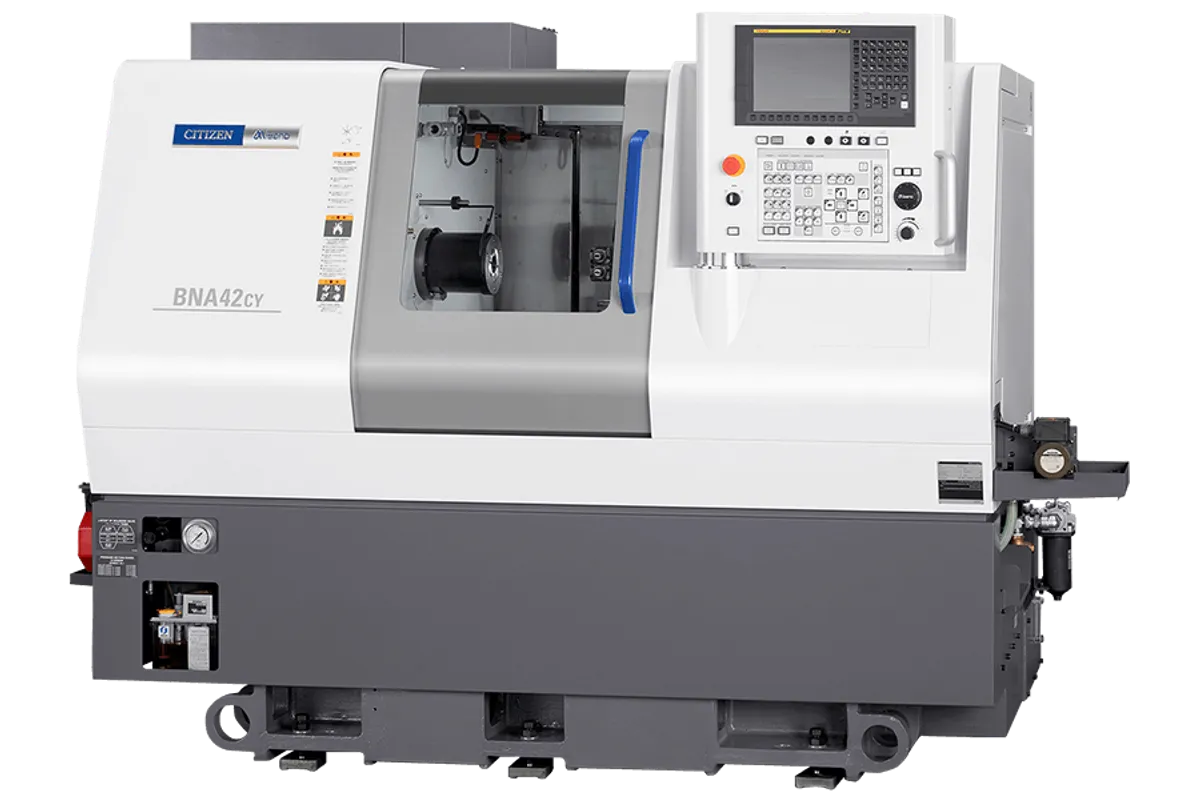
Image: cmj.citizen.co.jp, Citizen Machinery
Key Specifications
Max Spindle
max machining length
standard machining diameter
number of spindles
collet chuck type
power chuck type
How much does the Citizen Miyano BNA-42CY cost?
Estimated price range
Our best estimate for a cnc lathes / turning center in this class — not a quote from Citizen Machinery. Configuration moves it a long way.
Overview
The Miyano BNA-42CY is a single-spindle turning center with one 12-station turret and a Y axis, sized for 42 mm dia. bar and, in Citizen's words, a CY type that can also be used as a chucker. It takes 5" and 6" hollow chucks as well as collets, and its maximum machining length is 200 mm.
The spindle runs 60 - 6,000 rpm on a motor rated 11/7.5/5.5 kW (15%/15min/cont.): 11 kW at 15% duty, 7.5 kW for 15 minutes and 5.5 kW continuous. The continuous figure is the one to use when planning long roughing passes. Collet choice is wide, with Hardinge S20, DIN173E, B&S#22, JPN34 and HAINBUSH types listed, which helps a shop that already stocks one of those systems.
All 12 turret stations can take rotary tools, running 50 - 5,000 rpm on a 2.8/1.0 kW motor. With a Y axis, those tools can drill and mill off the part centreline. Feed rates are 20 m/min on X and Z and 23 m/min on Y. Turning tools are 20 mm Sq. and the tool post holes 25 mm dia.
There is no second spindle, so the cut-off face of a bar part needs a second operation, and that is the main thing to weigh against the two-spindle machines. In return, the BNA-42CY is a small installation: 16 kVA of power, W2,260×D1,433 mm of floor, 1,745 mm of height and 3,220 kg, against 6,250 kg for the Miyano ANX-42SYY.
Full Specifications
| Parameter | Value |
|---|---|
| Max Machining Length | 200 mm |
| Standard Machining Diameter | 42 mm dia. |
| Number of Spindles | 1 |
| Max Spindle Speed | 60 - 6,000 rpm |
| Collet Chuck Type | Hardinge S20, DIN173E, B&S#22, JPN34, HAINBUSH |
| Power Chuck Type | 5" and 6" hollow chucks |
| Number of Tool Posts | 1 |
| Type of Tool Post | 12st.Turret |
| Dimensions of Tools Used | 20 mm Sq. |
| Dimensions of Tool Post Holes | 25 mm dia. |
| Number of Installed Rotary Tools | max. 12 |
| Rotating Speed of Rotary Tools | 50 - 5,000 rpm |
| Feed Rate X Axis | 20 m/min |
| Feed Rate Z Axis | 20 m/min |
| Feed Rate Y Axis | 23 m/min |
| Spindle Motor | 11/7.5/5.5 kW(15%/15min/cont.) |
| Rotary Tools Motor | 2.8/1.0 kW |
| Power Requirement | 16 kVA |
| Machine Height | 1,745 mm |
| Required Floor Surface Area | W2,260×D1,433 mm |
| Machine Weight | 3,220 kg |
Specifications sourced from cmj.citizen.co.jp — verified 2026-10-03
Strengths & Limitations
Strengths
- Usable as a chucker with 5" and 6" hollow chucks, as well as for 42 mm dia. bar
- 200 mm maximum machining length
- Spindle motor 11/7.5/5.5 kW (15%/15min/cont.) with a 60 - 6,000 rpm range
- 12-station turret taking up to 12 rotary tools at 50 - 5,000 rpm
- Collet types listed: Hardinge S20, DIN173E, B&S#22, JPN34 and HAINBUSH
Limitations
- One spindle only: the back of the part needs a second operation
- Rotary tools rated 2.8/1.0 kW, enough for drilling and light milling only
- Rotary tools top out at 5,000 rpm, below the 6,000 rpm spindle
Best For
Frequently Asked Questions
01
Yes. Citizen describes the CY type as usable as a chucker machine, and the table lists 5" and 6" hollow chucks alongside collet chucks for bar work at the 42 mm dia. standard machining diameter.
02
No. The table lists one spindle and one tool post, a 12-station turret. Parts that need the cut-off face machined go to a second operation or to a two-spindle machine; for one-sided parts up to 200 mm long the single spindle is enough.
03
The spindle motor is rated 11/7.5/5.5 kW (15%/15min/cont.): 11 kW at 15% duty, 7.5 kW for 15 minutes and 5.5 kW continuous. The rotary tool motor is rated 2.8/1.0 kW and drives the tools at 50 - 5,000 rpm.
04
20 m/min on X and Z and 23 m/min on Y. The Y axis lets the rotary tools drill and mill away from the part centreline, so flats, cross holes and slots can be finished on the machine.
05
A 16 kVA supply, a floor area of W2,260×D1,433 mm and 1,745 mm of height; the machine weighs 3,220 kg. Add space for bar loading if it will run from bar rather than as a chucker.
More from Citizen Machinery
Other CNC Lathes / Turning Centers
You Ji VTL4500ATC
Huron AX M 200
Tsugami M08SD-II
Johnford ST-80CH
Harrison Alpha 1460XS