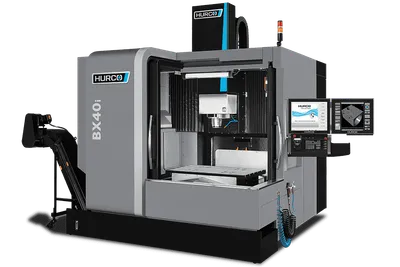
Burkhardt+Weber MFZ 400
Key Specifications
X Travel
Y Travel
Z Travel
Max Spindle
Tool Capacity
Table Size
Overview
The Burkhardt+Weber MFZ 400 is a precision milling and boring machining center in the mid-size segment, combining high-accuracy boring operations with full milling capability for complex prismatic workpieces. The MFZ designation — Milling and Boring Center — reflects the machine's dual identity: it delivers the precision spindle and rigidity of a dedicated boring machine while providing the flexibility of a multi-task machining center capable of face milling, end milling, pocket milling, drilling, and reaming.
The 400 designation refers to the nominal spindle diameter class and the machine's pallet or work zone sizing. The MFZ 400 uses a fixed-gantry or traveling column design with a high-rigidity spindle head capable of accepting boring bars up to 400 mm diameter reach range. This makes it well-suited for workpieces in the medium-weight class — diesel engine blocks, hydraulic manifolds, valve bodies, gearbox housings, and mid-size aerospace structural brackets — where precision bores must be combined with complex milled features in a single setup.
Burkhardt+Weber engineers the MFZ 400 with thermal symmetry as a primary design goal. The column and spindle carrier are designed for minimal thermal growth in production environments where temperature fluctuates between shifts. Integrated thermal compensation in the Siemens Sinumerik 840D sl control adjusts axis positions in real time based on sensor data from key structural points, maintaining bore positional accuracy within a few microns across full production shifts. The spindle uses a high-rigidity design with a large-diameter front bearing arrangement for minimal radial deflection under heavy boring cuts.
The MFZ 400 is typically configured with a rotary pallet table for four-sided complete machining and an automatic tool changer with 60–120 tool positions, enabling unattended machining of complex multi-face prismatic workpieces. Optional right-angle milling heads, extended reach boring heads, and probing systems for in-process measurement are available through the automatic head changer interface. This configurability makes the MFZ 400 a strong candidate for flexible manufacturing cells where one machine must handle a variety of part types across short production runs.
The MFZ 400 competes with the Parpas ML 35, TOS Varnsdorf WRF 130, and Juaristi JXR mid-size boring mill segment. Burkhardt+Weber positions the MFZ 400 as the precision choice for buyers who need tighter standard tolerances and better thermal compensation than the entry-level European boring mills provide, without stepping up to the full scale and cost of a floor-type large boring mill. It is a common choice for precision subcontractors serving the German automotive and Tier 1 aerospace supply chain.
Full Specifications
| Parameter | Value |
|---|---|
| Spindle Diameter | 80 mm (3.15 in) standard boring bar |
| X-Axis Travel | 2,000 mm (78.7 in) |
| Y-Axis Travel | 1,200 mm (47.2 in) |
| Z-Axis Travel | 800 mm (31.5 in) |
| Max Spindle Speed | 4,000 RPM |
| Spindle Motor Power | 40 kW (53.6 hp) |
| Spindle Torque | 1,800 Nm at S1 |
| Table Size | 1,000 x 1,000 mm (39.4 x 39.4 in) |
| Max Workpiece Weight | 5,000 kg (11,023 lb) |
| Rapid Traverse Rate | 20 m/min (787 ipm) |
| Tool Taper | HSK-A100 / SK 50 |
| Tool Capacity | 60 (expandable to 120) |
| CNC Control | Siemens Sinumerik 840D sl |
| Machine Weight | 25,000 kg (55,116 lb) approximate |
Specifications compiled from manufacturer literature and industry references. Not independently verified against a published spec sheet — confirm with the manufacturer or an authorised dealer before making a purchasing decision.
Strengths & Limitations
Strengths
- Combines dedicated boring machine precision with full milling center versatility, allowing diesel engine blocks, gearbox housings, and hydraulic manifolds to be completely machined in a single setup
- Active thermal compensation system with real-time sensor feedback maintains bore positional accuracy within single-digit microns across full production shifts without operator intervention
- Automatic head changer for right-angle heads, extended boring heads, and probing systems transforms the MFZ 400 into a genuinely flexible machining center for varied mid-size part production
- Siemens Sinumerik 840D sl control with comprehensive boring cycles, thread milling, and probing macro libraries reduces programming time for complex multi-bore workpieces
- German manufacturing pedigree from Burkhardt+Weber's century in large-format precision machining delivers long-term accuracy retention that reduces recalibration intervals in production environments
Limitations
- Price range of $600K–$1.2M places it above entry-level boring mills from TOS or similar builders; buyers must have sufficient precision workpiece volume to justify the investment
- Burkhardt+Weber machines are not widely stocked by North American machine tool dealers — most buyers purchase factory-direct or through European machine tool importers with longer lead times
- The MFZ 400's configuration complexity (head changer, rotary table, probing) means setup and commissioning requires experienced applications support; not a plug-and-play machine for shops unfamiliar with boring mill operations
Best For
Frequently Asked Questions
01
The MFZ 400 is a mid-size milling and boring center with a fixed-table or smaller rotary table configuration, designed for workpieces in the 500 kg–5,000 kg range. The MCX 800 is a large floor-type boring mill with traveling column and floor-plate design for very large workpieces (up to 15,000 kg). The MFZ 400 is faster and more flexible for varied mid-size work; the MCX 800 is the choice when workpiece size exceeds what a table-based machine can accommodate.
02
The MFZ 400 is primarily a milling and boring machine, not a turn-mill center. While it can perform circular interpolation to create round features, it does not have a turning headstock with rotating workpiece capability. Customers requiring turning combined with milling on large parts should consider the Burkhardt+Weber TCX 850 turn-mill center.
03
The standard configuration includes a 60-tool magazine. An expanded 120-tool magazine is available as an option. For production applications requiring a wider range of boring tools, milling cutters, and special heads, the expanded magazine is strongly recommended to support unattended multi-operation cycles.
04
The MFZ 400 uses Burkhardt+Weber's integrated thermal compensation system, which combines temperature sensors embedded in the machine structure (column, spindle carrier, ballscrew housings) with real-time position correction through the Siemens Sinumerik 840D sl control. The system compensates for thermal growth in all three linear axes and in the spindle extension. This eliminates the need for climate-controlled machine rooms in most production environments.
05
The MFZ 400 is primarily used in automotive powertrain manufacturing (engine blocks, transmission housings), aerospace structural machining (brackets, housings, frames), hydraulic equipment manufacturing (manifolds, valve blocks), and precision industrial equipment manufacturing (gearboxes, pump housings). It is particularly well-suited for the German and Central European automotive supply chain where multi-face prismatic machining to tight tolerances is a standard production requirement.
Community Discussions
Community discussion — Need Help! Ferranti MF400 Laser source - CNCzone
Community discussion — PROGRAMMING MANUAL - CNCzone
Electrical and installation requirements — Accu-rite MillPower - cnczone.com
Community discussion — Post Processor Files - CNCzone
Links to community discussions. Summaries are editorial — visit the original thread for full context.
Related Machines
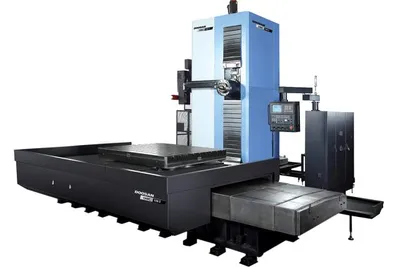
DN Solutions DBC-130
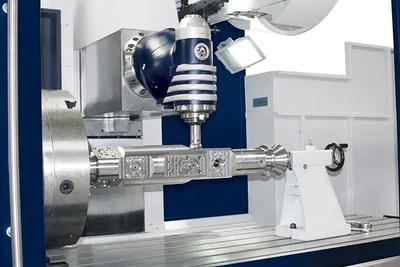
Soraluce TA-A 35
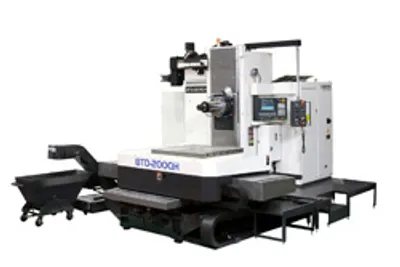
Toshiba BTD-200QH

DN Solutions DBC 130

DN Solutions DBD 130