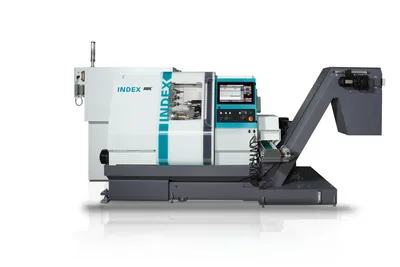
Acme-Gridley RA-6
Key Specifications
number of spindles
max bar diameter
spindle speed range
main spindle drive
cross slides
end working slides
How much does the Acme-Gridley RA-6 cost?
Estimated price range
Our best estimate for a multi-spindle automatic in this class — not a quote from Acme-Gridley. Configuration moves it a long way.
Overview
The Acme-Gridley RA-6 is a multi-spindle bar automatic listed for bar up to 1-5/8 in (41 mm), depending on configuration, on a machine weighing approximately 18,000 kg (40,000 lb). The listed figures describe two different machines under one name: the original, in which cams drive everything, and a CNC retrofit, in which servos do.
That split runs through the whole table. The main spindle drive is either mechanical or AC servo. Cross slides and end-working slides are either cam-driven or CNC servo-driven. Spindle speed has no figure at all; it is given as variable and dependent on gearing and on the retrofit specification. Anyone evaluating an RA-6 therefore has to establish first which of the two they are looking at, because setup method, changeover time and the skills needed to run it are not the same.
On a cam machine the job lives in the cams and the gearing. A new part means a new or re-timed cam set, which pays off on long runs of one part and costs time on short ones. On a retrofit the slide motions are programmed, and the control is listed as Siemens, Fanuc or Allen-Bradley depending on the retrofit. Ask for the retrofit documentation, since the listed figures say nothing about the scope of any conversion.
Bar feed is listed as magazine or hydrodynamic, and coolant as a centralized flood system. Check the floor for the 18,000 kg (40,000 lb) weight before the machine arrives.
Full Specifications
| Parameter | Value |
|---|---|
| Number of Spindles | 6 |
| Max Bar Diameter | 1-5/8 in (41 mm) depending on configuration |
| Spindle Speed Range | Variable, dependent on gearing and retrofit specification |
| Main Spindle Drive | Mechanical (cam-driven original) or AC servo (CNC retrofit) |
| Cross Slides | Cam-driven or CNC servo-driven (retrofit) |
| End Working Slides | Cam-driven or CNC servo-driven (retrofit) |
| Bar Feed | Magazine or hydrodynamic bar feed |
| CNC Control | Siemens, Fanuc, or Allen-Bradley (retrofit-dependent) |
| Coolant System | Flood coolant, centralized |
| Machine Weight | Approx. 18,000 kg (40,000 lb) |
| Spindle Hole Dia | 2.625 in |
| Spindles | 8.0 spdl |
Specifications sourced from machinetools.com — verified 2026-03-28
Strengths & Limitations
Strengths
- Takes bar up to 1-5/8 in (41 mm), depending on configuration
- Spindle drive and slides are cam-driven on the original and servo-driven on a CNC retrofit
- Bar feed is listed as magazine or hydrodynamic
- Centralized flood coolant system
Limitations
- No spindle speed figure is listed; speed depends on gearing and retrofit specification
- A cam-driven original needs its cams and gearing changed for each new part
- The control is Siemens, Fanuc or Allen-Bradley depending on the retrofit, so two converted machines need not be alike
- At approximately 18,000 kg (40,000 lb), foundation and rigging need planning
Best For
Frequently Asked Questions
01
The listed maximum bar diameter is 1-5/8 in (41 mm), depending on configuration. Bar is loaded by a magazine or hydrodynamic bar feed. Look at the collets and feed tubes that come with a machine, since they decide which sizes it can run without more tooling.
02
It can be either. The listed figures give a mechanical, cam-driven original and a CNC retrofit with an AC servo main spindle drive and servo-driven cross slides and end-working slides. Which one applies depends on the individual machine.
03
The control row lists Siemens, Fanuc or Allen-Bradley, and marks the choice as retrofit-dependent. An original cam-driven machine has no CNC. Ask for the retrofit documentation to see which control was fitted and which motions it drives.
04
Machine weight is listed as approximately 18,000 kg (40,000 lb). Coolant is a centralized flood system. Both need to be allowed for when planning the foundation, the rigging and the position of the machine in the shop.
Community Discussions
Links to community discussions. Summaries are editorial — visit the original thread for full context.
More from Acme-Gridley
Other Multi-Spindle Automatics
INDEX MS20-6
Schütte SC 32 CNC